What causes most bearing failures in industrial equipment?
Lubrication failure is the leading cause of bearing failure in industrial equipment, responsible for a substantial proportion of all bearing breakdowns. When lubrication is absent, insufficient, contaminated, or the wrong type for the application, the protective film between rolling elements and raceways breaks down, allowing direct metal contact, heat generation, and accelerated wear. Other major causes include misalignment, overloading, contamination, improper installation, and electrical current passage through the bearing.
In practice, most bearing failures in industrial settings are not caused by a single factor in isolation. Lubrication problems and misalignment frequently act together: misalignment increases the load on individual rolling elements, which in turn depletes the lubricant film faster and raises operating temperatures. Once temperatures rise, lubricant viscosity drops further, compounding the problem.
Contamination is another significant driver of bearing damage. Particles entering the bearing housing, whether metallic debris from adjacent components, process dust, or moisture, score the raceways and rolling elements. Even small particles can initiate surface fatigue that develops into spalling over time. In industries such as mining, pulp and paper, and food processing, contamination control is a constant challenge and a primary reason why bearing service life in those environments is often shorter than the manufacturer's rated life.
Improper installation rounds out the main causes. Forcing a bearing onto a shaft using the wrong method, applying load through the rolling elements rather than the ring being fitted, or using an incorrectly sized housing can introduce pre-stress, brinelling, or misalignment from the moment the machine starts. These installation-induced defects may not cause immediate failure but create the conditions for early fatigue.
What are the early warning signs of bearing failure?
The earliest warning signs of bearing failure are abnormal noise, elevated temperature, increased vibration, and changes in lubricant condition. These indicators typically appear well before the bearing reaches the point of functional failure, giving maintenance teams a window to plan intervention rather than respond to an unplanned breakdown. Detecting them early is the foundation of condition-based maintenance.
Noise and vibration changes
A healthy bearing running under normal conditions produces a consistent, low-level hum. As surface damage develops, rolling elements passing over pits, spalls, or scoring generate characteristic frequencies that appear in vibration spectra. Ultrasonic listening devices can detect early-stage defects that produce high-frequency stress waves long before the damage is audible to the human ear. Grinding, squealing, or irregular clicking sounds at audible frequencies typically indicate more advanced damage.
Vibration amplitude increases are measurable with accelerometers mounted on bearing housings. Trending vibration data over time reveals whether the machine is operating within its normal envelope or whether bearing condition is deteriorating. A sudden step-change in vibration, rather than a gradual trend, often points to a specific event such as contamination ingress or a lubrication failure episode.
Temperature and lubricant condition
Bearing operating temperature is a reliable indicator of lubrication effectiveness. A bearing running hotter than its established baseline, without a corresponding change in load or ambient conditions, signals that the lubricant film is thinning or that friction is increasing. Infrared thermometers and thermal imaging cameras make temperature monitoring practical during routine rounds without stopping the machine.
Lubricant condition itself carries diagnostic information. Darkened grease, metallic particles in oil samples, or a burnt smell from a bearing housing all indicate that the lubricant has been degraded by heat or contaminated by wear debris. Oil analysis programs used in larger installations can quantify particle counts and identify the metal type, helping engineers pinpoint which component is generating the wear.
How does misalignment damage bearings over time?
Misalignment damages bearings by imposing forces and moments on the rolling elements and raceways that the bearing was not designed to carry in that direction. Even small angular or radial offsets between a motor shaft and a driven shaft translate into cyclically varying loads on the bearings supporting both shafts. Over time, these abnormal loads accelerate surface fatigue, reduce lubricant film thickness, and shorten bearing service life significantly compared to a correctly aligned installation.
There are two distinct forms of misalignment that affect bearings in rotating equipment. Static misalignment is the offset present at the moment of installation, typically measured and corrected during alignment procedures. Dynamic misalignment develops during operation as thermal expansion of the motor, driven machine, and baseplate causes shaft centrelines to shift from their cold, stationary positions. Dynamic misalignment is harder to eliminate because it changes with load, temperature, and operating time.
The forces generated by misalignment do not stay within the coupling. Conventional flexible couplings, whether jaw, pin-and-bush, gear, or disc types, accommodate misalignment through elastic deformation or sliding contact within the coupling element itself. However, this accommodation still transmits reaction forces back into the motor and driven-equipment bearings. The bearing load pattern shifts from the designed uniform distribution to a concentrated load on one side of the raceway, which is the classic condition for accelerated rolling contact fatigue.
Industry experience consistently identifies misalignment as one of the most significant contributors to premature bearing failure in rotating machinery. Installations where alignment is checked only at commissioning and not re-verified after thermal stabilisation or after maintenance interventions are particularly vulnerable, because the dynamic operating condition may differ substantially from the cold static condition recorded during installation.
What is the difference between fatigue failure and lubrication failure in bearings?
Fatigue failure and lubrication failure are distinct bearing failure modes with different root causes, progression patterns, and visual signatures. Fatigue failure results from cyclic stress in the bearing material eventually exceeding its endurance limit, producing subsurface cracks that propagate to the surface as spalling. Lubrication failure results from the breakdown of the protective film between rolling surfaces, causing direct metal contact, adhesive wear, and rapid surface degradation. In practice, the two modes often interact.
Rolling contact fatigue
Pure rolling contact fatigue is the failure mode that bearing life rating standards, such as ISO 281, are designed to predict. Every revolution of a bearing subjects the raceway and rolling elements to a stress cycle. After a sufficient number of cycles, microscopic cracks initiate below the surface at stress concentration points, typically inclusions in the steel or surface irregularities. These cracks grow with continued loading until they reach the surface and produce spalling, which appears as pitting or flaking of the raceway surface.
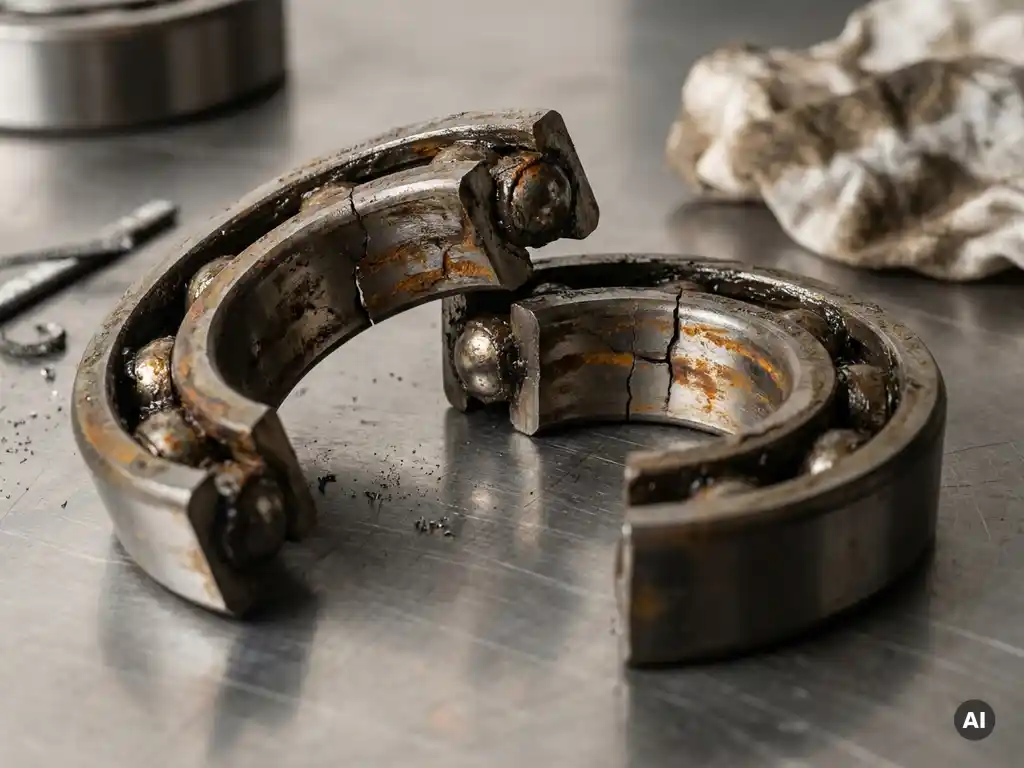
Fatigue failure has a characteristic appearance: the spalled area has a rough, irregular texture with a distinct boundary, and the surrounding material remains relatively smooth. Fatigue-related failure is expected to occur eventually in any bearing that reaches its design life, but it should not occur prematurely in a correctly installed, properly lubricated, and appropriately loaded bearing.
Lubrication-related failure
Lubrication failure produces a different failure signature. When the oil or grease film is insufficient, rolling elements and raceways contact directly, generating adhesive wear, smearing, and surface glazing. The failed surfaces show polishing, scoring, or welding marks rather than the spalled pitting characteristic of fatigue. Heat generated by metal contact can discolour the steel, producing a blue or brown tint on raceway surfaces.
Lubrication failure progresses much faster than fatigue failure under the same load conditions, because the absence of a protective film removes the primary mechanism that keeps stress levels within the material's endurance limit. A bearing that might last years under correct lubrication can fail within hours when running dry or with degraded lubricant. This is why lubrication management, including correct selection, quantity, application interval, and contamination control, is the single most impactful maintenance practice for extending bearing service life.
How does bearing failure affect energy consumption and maintenance costs?
Bearing failure drives up energy consumption and maintenance costs simultaneously. A deteriorating bearing increases friction within the drivetrain, requiring the motor to draw more current to maintain the same output speed and torque. On the cost side, bearing failures trigger unplanned stoppages that carry costs far beyond the price of the bearing itself, including lost production, emergency labour, ancillary component damage, and the administrative burden of unplanned work orders.
The energy impact of a failing bearing is measurable but often overlooked in routine operations. Increased internal friction raises the bearing's operating temperature and reduces the mechanical efficiency of the rotating assembly. In applications such as pumps and fans that run continuously, even a modest efficiency reduction compounds into significant additional electricity consumption over weeks or months of deteriorating operation before the failure becomes visible.
The maintenance cost consequences of bearing failure extend well beyond the replacement bearing itself. Unplanned downtime is consistently the largest cost element in rotating equipment maintenance. A bearing failure that stops a production line or a pump station triggers a cascade of costs: emergency procurement, overtime labour, permit-to-work administration, potential damage to adjacent components such as seals and shafts, and the production value of the lost operating hours. In process industries where output is continuous and interruptions affect downstream operations, the cost of a single unplanned bearing failure can be orders of magnitude larger than the cost of the bearing.
Repeated bearing failures in the same location also signal an underlying problem that is not being addressed, whether misalignment, overloading, contamination ingress, or an incorrect lubricant specification. Each replacement cycle that does not address the root cause restarts the failure clock rather than solving the problem, accumulating maintenance spend without improving reliability.
How can bearing failures be prevented in rotating equipment?
Bearing failures in rotating equipment are prevented through a combination of correct installation, disciplined lubrication management, alignment control, contamination exclusion, and condition monitoring. No single measure is sufficient on its own, but addressing all five systematically produces a step-change improvement in bearing service life and drivetrain reliability. The most effective prevention programs treat bearing health as a system outcome rather than an isolated component issue.
- Correct installation: Bearings must be fitted using appropriate methods, applying force only through the ring being seated, using correct tools, and verifying that housing fits and shaft tolerances are within specification. Brinelling and pre-stress introduced during installation create immediate failure precursors.
- Lubrication management: Select the correct lubricant type and viscosity for the operating temperature and speed. Apply the right quantity at the right interval, and monitor lubricant condition through oil analysis or grease inspection. Over-greasing is as damaging as under-greasing, generating heat through churning.
- Alignment control: Achieve precise shaft alignment at installation and verify alignment after thermal stabilisation. Where dynamic misalignment during operation is unavoidable due to thermal growth or foundation movement, consider coupling technologies that structurally eliminate the transmission of misalignment forces into bearings rather than simply accommodating them.
- Contamination exclusion: Maintain bearing housing seals in good condition and use appropriate seal types for the process environment. In contaminated environments, labyrinth seals, lip seals, or purged housings can significantly extend bearing life compared to basic shielded bearings.
- Condition monitoring: Implement vibration monitoring, temperature trending, and oil analysis to detect early-stage bearing degradation. Condition monitoring extends the P-F interval, the time between detectable degradation and functional failure, giving maintenance teams time to plan replacement during scheduled windows rather than reacting to breakdowns.
Addressing misalignment at its source is particularly high-leverage because it simultaneously reduces bearing load, extends lubricant film life, and lowers vibration levels throughout the drivetrain. When dynamic misalignment during operation cannot be controlled through alignment procedures alone, the coupling technology connecting the motor to the load becomes a critical reliability variable.
How Zytec helps prevent bearing failure in rotating equipment
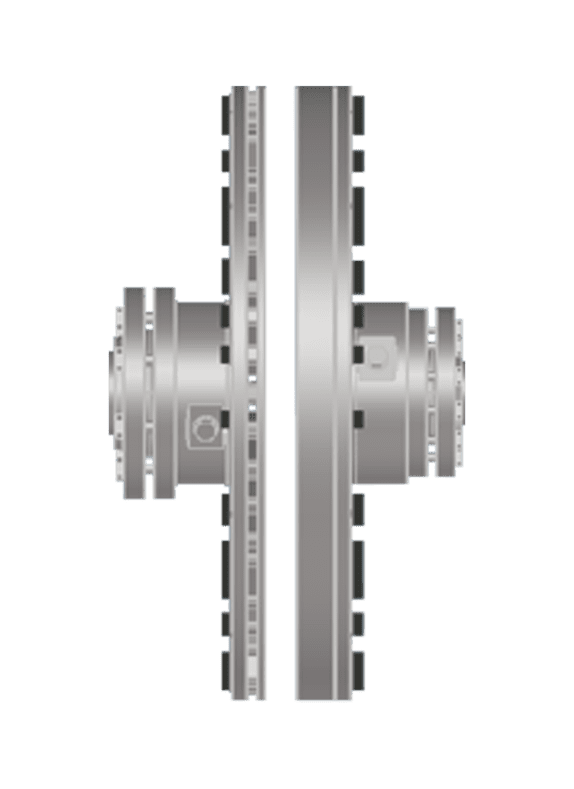
Zytec's non-contact drives address bearing failure at its most persistent root cause: the transmission of misalignment forces and torsional shock loads through the drivetrain. Because Zytec's F-TORQ Non-Contact Coupling transmits torque across an air gap using eddy current magnetic coupling, there is no physical contact between the motor shaft and the driven load. This means misalignment forces, whether static or dynamic, are structurally eliminated rather than merely accommodated. The result is a drivetrain where bearings, seals, and shafts operate under stable, predictable load conditions throughout the asset's life.
The practical benefits for bearing health and maintenance costs are concrete:
- No misalignment-induced bearing overload: The coupling transmits zero radial or torsional stiffness into the drivetrain, removing the primary mechanical driver of premature bearing fatigue.
- No scheduled coupling maintenance: The F-TORQ contains no wear components, no elastomers, and no lubrication systems, eliminating the maintenance interventions that frequently introduce human error and reinstall misalignment.
- Extended bearing and seal service life: By removing coupling-induced peak loads and torsional oscillations, every downstream component operates under lower stress, extending the P-F curve and reducing the frequency of bearing replacements.
- Soft-start capability: The non-contact drive absorbs start-up torque peaks that would otherwise transmit shock loads into bearings, particularly valuable in high-inertia applications.
- Energy savings up to 50%: Lower drivetrain friction and optimised speed control reduce motor current draw, directly lowering electricity consumption alongside maintenance costs.
For industrial operations where bearing failures are a recurring cost and reliability challenge, Zytec's non-contact drive technology offers a structurally different approach, one that eliminates the failure pathway rather than managing its consequences. Contact Zytec to discuss how the F-TORQ or A-TORQ can be applied to your specific rotating equipment installation.
Frequently Asked Questions
How often should bearing lubrication be checked or replenished in industrial equipment?
Relubrication intervals depend on bearing size, operating speed, temperature, and environmental conditions, so there is no universal answer. As a starting point, most bearing manufacturers provide relubrication interval calculators based on these variables, and those figures should be treated as a maximum rather than a target. In practice, oil analysis and grease inspection programs are the most reliable way to set site-specific intervals, because they reflect actual operating conditions rather than theoretical ones. Remember that over-greasing is a genuine failure risk: forcing excess grease into a housing raises churning temperatures and can damage seals.
What is the most common mistake made during bearing installation, and how can it be avoided?
The most common installation mistake is applying fitting force through the rolling elements rather than directly through the ring being seated, which causes brinelling — small indentations on the raceways that become stress concentration points and initiate early fatigue. The correct approach is to use purpose-made fitting tools, a bearing heater for interference-fit inner rings, or a hydraulic nut for larger bearings, always ensuring that force is transmitted through the ring in contact with its mating surface. Verifying shaft and housing tolerances before fitting is equally important, as an undersized or oversized fit introduces pre-load or looseness that no installation technique can correct after the fact.
How do I know whether a recurring bearing failure in the same location is a lubrication problem or a misalignment problem?
The failure signature on the bearing itself is the most direct diagnostic clue: lubrication failure typically produces polishing, scoring, smearing, or heat discolouration on the raceway, while misalignment-driven fatigue produces concentrated spalling on one side of the raceway rather than uniformly around it. Vibration data collected before failure can also help — misalignment produces characteristic frequency patterns at 1× and 2× running speed, whereas lubrication-related degradation tends to raise broadband noise and bearing defect frequencies. In many recurring failures, both factors are present, so addressing only one will not break the replacement cycle; a thorough root cause analysis should evaluate lubrication specification, application interval, and shaft alignment condition together.
Can condition monitoring really give enough warning to avoid unplanned downtime, or does bearing failure happen too quickly?
For most bearing failure modes, condition monitoring does provide a meaningful warning window, but the length of that window depends on the failure mode and how early monitoring begins. Vibration analysis and ultrasonic monitoring can detect early-stage surface defects weeks or even months before functional failure in many applications, giving maintenance teams time to plan a replacement during a scheduled shutdown. The exception is lubrication failure, which can progress from normal operation to catastrophic failure within hours if a bearing runs dry, which is why lubrication management and contamination control must be treated as the first line of defence rather than relying on monitoring alone to catch problems after they start.
Is shaft alignment really necessary if I'm already using a flexible coupling?
Yes — flexible couplings accommodate misalignment by deforming or sliding internally, but they still transmit reaction forces back into the motor and driven-equipment bearings. The coupling element absorbs the offset, but the physics of doing so generates radial and axial forces that load the adjacent bearings beyond their designed operating envelope. Flexible couplings are designed to tolerate small residual misalignment after a careful alignment procedure, not to substitute for one. Treating a flexible coupling as a misalignment solution rather than a misalignment tolerance leads directly to the accelerated bearing fatigue and shortened coupling life that the post describes.
What contamination control measures are most effective in harsh environments like mining or food processing?
In high-contamination environments, the most effective measures are selecting the right seal type for the specific contaminant, maintaining positive pressure inside the housing where possible, and establishing a regular seal inspection routine so that worn or damaged seals are replaced before contamination enters. Labyrinth seals and V-ring seals offer significantly better exclusion than basic contact seals for airborne dust and process debris, while purged or pressurised housings are used in the most aggressive applications. Equally important is ensuring that relubrication practices themselves do not introduce contamination: grease fittings should be wiped clean before use, and grease guns should be dedicated to a single lubricant type to prevent cross-contamination.
How can I build a business case for investing in better bearing reliability practices when bearing replacements seem relatively inexpensive?
The bearing itself is almost always the smallest cost element in a bearing failure event — the real costs are unplanned downtime, emergency labour, ancillary component damage, and lost production, which can be orders of magnitude larger. To build a credible business case, calculate the total cost of each unplanned bearing failure event at a specific asset: include the production value of lost hours, overtime and call-out labour rates, expedited parts procurement, and any downstream process disruption. Then compare that figure against the annualised cost of a structured prevention program covering lubrication management, alignment verification, and condition monitoring. In most industrial settings, even a modest reduction in unplanned bearing failures produces a return that justifies the investment within the first year.