Identify the Root Cause of Fan Vibration
Before touching any hardware, your first task is to understand what is actually causing the vibration. Jumping straight to disassembly without a diagnosis wastes time and risks missing the real problem. Fan vibration causes fall into several distinct categories, and each one points to a different fix.
Start by gathering data while the fan is running. Use a vibration analyzer or handheld vibration meter to take measurements at the bearing housings on both the drive end and the non-drive end. Record the vibration amplitude and frequency. The frequency signature is your most valuable diagnostic clue: vibration at rotational frequency (1x) typically points to imbalance, while vibration at 2x often indicates misalignment. Higher-order harmonics or broadband noise can suggest bearing damage, aerodynamic turbulence, or structural resonance.
- Measure vibration amplitude (mm/s or in/s) at all bearing housings while the fan runs at operating speed.
- Record the dominant frequency and compare it to the fan's rotational speed in Hz.
- Check for any recent changes: a new installation, recent maintenance, process changes, or seasonal temperature shifts that may have triggered the problem.
- Inspect the fan visually for obvious signs of blade damage, buildup of material on the impeller, or structural looseness at the base frame.
After this initial assessment, you should have a working hypothesis about the primary cause. Common culprits in industrial fan vibration include imbalance from blade buildup or damage, shaft misalignment between the motor and fan, worn or damaged bearings, a deteriorating coupling, or a combination of these factors. With your diagnosis in hand, move through the following steps in sequence.
Correct Imbalance and Misalignment Issues
Imbalance and misalignment are the two most frequent drivers of fan vibration in rotating equipment, and they are often present simultaneously. Addressing them early removes the largest sources of dynamic force before you inspect components that may have been damaged as a result.
Correcting Imbalance
Inspect the impeller thoroughly for uneven material buildup, erosion, or physical damage to the blades. Even a small accumulation of dust, scale, or process material on one side of the impeller creates a significant mass imbalance at operating speed. Clean the impeller completely, ensuring that all blades are equally clean, and re-inspect for cracks or missing material.
- Clean all fan blades using appropriate methods for your process environment (pressure washing, brushing, or chemical cleaning).
- Check each blade for erosion, cracks, or deformation, and replace damaged blades if necessary.
- If vibration persists after cleaning, perform dynamic balancing in-situ using a portable balancing kit or send the impeller for workshop balancing.
- Add balancing weights to the impeller in the locations indicated by the balancing instrument, following the manufacturer's specification for weight placement.
Correcting Misalignment
Shaft misalignment between the motor and the fan generates cyclic forces that are transmitted through the coupling into both sets of bearings. Use a laser alignment tool rather than a dial indicator for accurate results, particularly on larger drives where small angular errors have a significant impact.
- Mount laser alignment targets on both shafts and rotate them to capture alignment readings at multiple positions.
- Adjust the motor position using shims under the motor feet to correct vertical angular and offset misalignment.
- Use the lateral adjustment bolts on the motor base to correct horizontal misalignment.
- Re-check alignment after tightening all hold-down bolts, as tightening often shifts the motor position slightly.
After correcting both imbalance and misalignment, take a new set of vibration readings at the bearing housings. You should see a measurable reduction in the 1x and 2x frequency components. If vibration levels are still elevated, proceed to inspect the bearings and coupling.
Inspect and Replace Worn Bearings and Couplings
Even after correcting imbalance and misalignment, worn bearings and a degraded coupling can sustain or even amplify vibration. Bearings that have operated under excessive vibration for a period will have developed surface fatigue, and a coupling that has absorbed years of misalignment forces may have cracked inserts, worn teeth, or deteriorated flexible elements.
Shut the fan down safely and lock out the energy source before beginning any mechanical inspection. Remove the coupling guard and examine the coupling element carefully. Jaw couplings with cracked or compressed spider inserts, pin-and-bush couplings with worn bushes, and gear couplings with pitted or worn teeth all introduce torsional irregularities and radial play that generate vibration. Replace the coupling element if you find any of these signs of wear.
- Remove the coupling guard and visually inspect the coupling element for cracks, compression set, wear, or missing material.
- Check for radial play by attempting to move the driven shaft relative to the motor shaft with the fan stationary.
- Inspect the bearing housings for signs of overheating (discoloration, grease leakage, or heat marks on the housing surface).
- Use a bearing condition monitoring tool (ultrasound or vibration spectrum analysis) to assess bearing condition before disassembly.
- Replace bearings that show signs of fatigue, pitting, or contamination, and ensure the replacement bearings are installed with the correct interference fit and preload.
When reinstalling, re-grease bearings to the correct quantity specified by the manufacturer. Over-greasing is a common mistake that generates heat and can actually accelerate bearing failure. After reassembly, run the fan briefly and re-measure vibration to confirm the improvement before returning to full operation.
Eliminate Drivetrain Vibration with a Non-Contact Drive
When conventional maintenance steps reduce but do not fully eliminate vibration, or when the same vibration problems return repeatedly after each maintenance cycle, the root cause is often the mechanical coupling itself. Traditional flexible couplings, regardless of their design, maintain physical contact between the motor and the driven shaft. This means that misalignment forces, torsional shocks, and vibration are continuously transmitted through the drivetrain, loading the bearings and seals of both the motor and the fan.
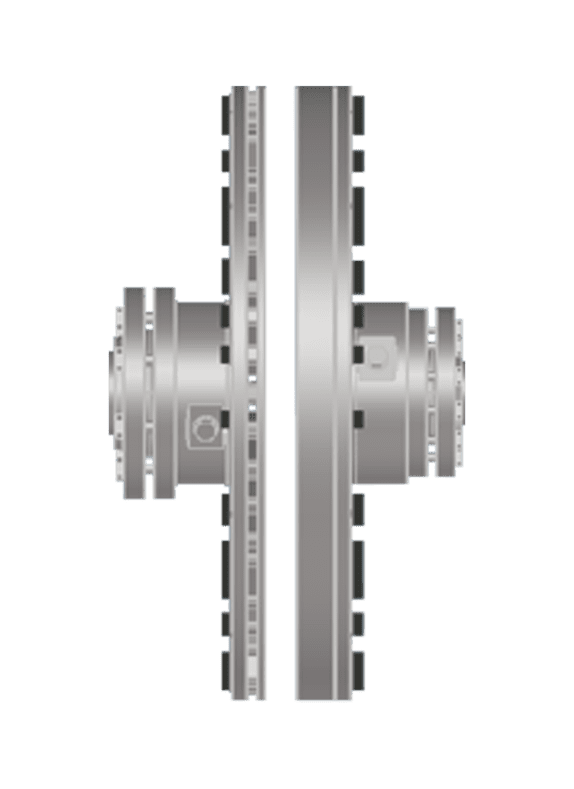
A fundamentally different approach is to replace the mechanical coupling with a non-contact magnetic drive. Zytec's non-contact drives transmit torque across an air gap using eddy current magnetic coupling, with no physical connection between the motor shaft and the fan shaft. Because there is no contact, misalignment-induced reaction forces are structurally eliminated rather than merely dampened. Torsional vibration cannot propagate across the air gap, and shock loads from process upsets do not transfer into the motor or fan bearings.
The practical result for industrial fan applications is substantial. Zytec's technology delivers vibration reduction of up to 80%, and because the drivetrain is no longer transmitting cyclic mechanical stress, bearing and seal service life extends dramatically. Installations that previously required frequent bearing replacements have operated maintenance-free for extended periods after switching to a non-contact drive. The coupling also provides inherent overload protection: if the fan is suddenly overloaded, the magnetic coupling slips rather than transmitting the shock load into the motor.
For fans requiring variable speed control, the V-TORQ Non-Contact Drive adds a Motor Sliding Base that adjusts the air gap continuously during operation, providing full variable-speed process control without the need for a Variable Frequency Drive. This is particularly relevant for fans in hazardous area (ATEX) installations, where VFD installation requires significant additional infrastructure, cabling, and enclosure costs.
Verify Results and Monitor Vibration Levels Over Time
After completing the corrective steps above, systematic verification is essential. A single post-repair measurement is not sufficient to confirm that the problem is resolved. Vibration levels in rotating equipment can shift as the machine reaches thermal equilibrium, as process loads vary, and as any residual imbalance or misalignment makes itself apparent under different operating conditions.
- Run the fan at full operating speed and take vibration measurements at all bearing housings after 30 minutes of operation, once the machine has reached thermal equilibrium.
- Compare the new readings against your baseline measurements from the diagnostic phase and against the ISO 10816 or ISO 20816 vibration severity guidelines for your machine class.
- Record the results in your maintenance management system as a new baseline for ongoing monitoring.
- Schedule follow-up vibration checks at 30 days, 90 days, and 6 months to confirm that vibration levels remain stable.
Establish a regular vibration monitoring program for the fan going forward. Route-based monitoring using a handheld analyzer, or continuous online monitoring for critical fans, gives you early warning of developing problems before they reach the point of failure. Trending vibration data over time is far more valuable than any single measurement, as it allows you to distinguish normal variation from a genuine deterioration trend and plan maintenance proactively rather than reactively.
With stable, low vibration levels confirmed and a monitoring program in place, your fan system is operating as it should, with maximum reliability and minimum stress on its components.
How Zytec Helps Reduce Vibration in Industrial Fans
When standard maintenance measures are not enough to keep fan vibration under control, Zytec offers a structural solution that addresses the problem at its source. By replacing the mechanical coupling with a non-contact magnetic drive, Zytec removes the physical connection through which vibration, misalignment forces, and torsional shocks travel through the drivetrain. The result is a fan system that runs quieter, lasts longer, and demands significantly less maintenance attention.
Zytec's non-contact drives are engineered specifically for rotating equipment in demanding industrial environments, including fans in general industry, HVAC, water and wastewater, chemical plants, oil and gas, and mining. Key benefits for fan applications include:
- Vibration reduction up to 80%, achieved by eliminating mechanical contact and the transmission of misalignment-induced forces
- Extended bearing and seal life, because cyclic mechanical stress is no longer transferred through the drivetrain
- No coupling maintenance required, removing a routine maintenance task and reducing exposure to rotating equipment
- Built-in overload protection, as the magnetic coupling slips under excessive load rather than transmitting shock into the motor or fan
- Variable speed capability with the V-TORQ drive, enabling energy savings of up to 50% without the infrastructure costs of a conventional VFD
- Fast installation, with no laser alignment required and reuse of existing motor and cabling
If your fan is experiencing persistent vibration that returns after each maintenance cycle, or if you are looking to reduce the total cost of ownership of your fan installations, contact Zytec to discuss which non-contact drive solution fits your application.
Frequently Asked Questions
How do I know whether my fan vibration problem is severe enough to require immediate shutdown, or can it continue operating while I plan repairs?
Use ISO 10816 or ISO 20816 vibration severity guidelines as your reference — these define acceptable vibration limits by machine class and mounting type. If your measurements fall into Zone C (potentially damaging) or Zone D (dangerous), the fan should be taken out of service as soon as safely possible. For readings in Zone B, continued operation is generally acceptable for a defined period, but you should schedule corrective maintenance promptly and increase monitoring frequency in the meantime.
What is the most common mistake maintenance teams make when trying to fix fan vibration?
The most frequent mistake is replacing bearings without first correcting the underlying imbalance or misalignment that caused them to fail. New bearings installed into a drivetrain that still has a 1x imbalance force or angular misalignment will simply fail again within a fraction of their rated service life. Always follow the diagnostic sequence — identify the root cause, correct imbalance and misalignment first, then replace worn components.
How often should I perform vibration measurements on industrial fans as part of a preventive maintenance program?
For most industrial fans, monthly route-based measurements with a handheld vibration analyzer provide a good balance between early fault detection and resource cost. For critical fans whose failure would cause significant production loss or safety risk, continuous online monitoring with automated trending and alarm thresholds is worth the additional investment. In either case, trending data over time is more valuable than any individual reading — a gradual upward trend in vibration amplitude is your earliest warning of a developing problem.
Can a non-contact magnetic drive be retrofitted to an existing fan installation, or does it require a new motor and fan unit?
Zytec's non-contact drives are designed as retrofit solutions that mount between your existing motor and fan shaft, reusing the current motor, cabling, and structural baseframe. Because no laser alignment is required during installation, retrofit time is significantly shorter than a conventional coupling replacement. The main site requirement is sufficient axial space between the motor and fan shaft to accommodate the drive assembly, which Zytec's engineering team can assess during the application review.
If my fan operates in a dusty or corrosive environment, will material buildup on the impeller always come back after balancing?
In many process environments, yes — buildup will recur, which is why in-situ dynamic balancing and a regular cleaning schedule are more practical long-term strategies than a one-time workshop balance. If buildup is the dominant recurring cause of vibration, consider whether blade geometry or surface coating changes can reduce adhesion, and whether your cleaning interval can be shortened to keep imbalance within acceptable limits between planned maintenance stops. A non-contact magnetic drive also provides tolerance to gradual imbalance buildup by isolating the motor from the resulting vibration forces.
What is the difference between using a Variable Frequency Drive (VFD) and a non-contact magnetic drive like the V-TORQ for fan speed control, and which is better for my application?
A VFD controls fan speed electronically by varying the frequency of the power supply to the motor, while the V-TORQ adjusts speed mechanically by changing the air gap between the magnetic elements — with no electrical connection between motor and fan shaft. VFDs are well-established and offer precise speed control, but they require harmonic filtering, screened cabling, compatible motor insulation, and in hazardous (ATEX) areas, certified enclosures and significant additional infrastructure. The V-TORQ eliminates most of that infrastructure, making it particularly cost-effective for hazardous area installations or sites where VFD installation costs are prohibitive.
After completing all the corrective steps, my vibration readings have improved but are still slightly above the ISO guideline limits. What should I check next?
If vibration remains elevated after correcting imbalance, misalignment, bearings, and coupling, the next area to investigate is structural resonance — a condition where the fan's operating speed coincides with a natural frequency of the support structure or baseframe. Check whether the dominant vibration frequency matches the fan's rotational speed exactly, and perform a bump test or run-up/coast-down measurement to identify any resonant frequencies in the structure. Solutions include stiffening or adding mass to the baseframe, changing the fan operating speed if the process allows, or installing vibration isolation mounts between the fan and its support structure.