The first signs of bearing failure are unusual noise, abnormal heat, and increased vibration coming from rotating equipment. These warning signals appear well before a bearing reaches the point of complete breakdown, giving maintenance teams a critical window to act. Understanding what each symptom looks and feels like — and what it means for the wider drivetrain — can be the difference between a planned repair and a costly unplanned shutdown.
What causes bearings to fail in industrial equipment?
Bearings in industrial equipment fail primarily due to misalignment, inadequate lubrication, contamination, overloading, and fatigue from accumulated operating hours. In most industrial settings, misalignment is the dominant root cause — industry experience consistently points to misalignment as responsible for a significant share of rotating machinery failures, with estimates frequently ranging between 30 and 50 percent of all bearing-related breakdowns.
When a shaft is even slightly out of alignment, the bearing races and rolling elements experience uneven load distribution. Rather than carrying the load across the full contact surface, the bearing absorbs concentrated stress at specific points. Over time, this causes micro-cracking, spalling, and accelerated surface fatigue that shortens bearing service life dramatically.
Lubrication failure is the second most common cause. Too little lubricant leads to metal-to-metal contact and frictional heat. Too much creates churning losses and elevated temperatures that break down the lubricant itself. Contamination from particles, moisture, or process fluids compounds both problems by acting as an abrasive between the rolling elements and raceways.
Electrical bearing currents — a growing issue in variable frequency drive applications — cause pitting and fluting of the bearing surfaces through repeated micro-discharges. Mechanical overloading, whether from shock loads, torsional oscillations, or resonance events in the drivetrain, adds further stress that accelerates the progression toward failure.
What does bearing failure sound like?
A failing bearing produces distinctive sounds that change as the damage progresses. In the early stages, the most common bearing failure sound is a faint, high-frequency hissing or crackling — often described as a grinding or rough rolling noise — that differs from the normal operating tone of the machine. As wear advances, this typically develops into rhythmic clicking, rumbling, or a pronounced metallic screech.
The specific character of the noise reflects the type of damage present. A regular clicking or ticking that repeats with shaft rotation often indicates a localized defect such as a spall or pit on a race or rolling element. A continuous, rough rumbling suggests more widespread surface degradation across the bearing. A high-pitched squeal frequently points to lubrication starvation, where metal surfaces are running in direct contact without adequate film separation.
Experienced maintenance engineers learn to distinguish these sounds by listening with a stethoscope or vibration-sensitive instrument placed directly on the bearing housing. Ultrasonic detection tools make early-stage noise detection possible long before the sound becomes audible to the unaided ear, extending the window for planned intervention.
How does abnormal heat signal a failing bearing?
Abnormal heat is one of the most reliable early signs of bearing failure. A healthy bearing operating under normal conditions generates a predictable, stable temperature. When that temperature rises noticeably above the established baseline — particularly if the rise is localized to the bearing housing rather than the surrounding equipment — it signals that something inside the bearing is generating excess friction or that the lubricant is no longer functioning correctly.
The mechanism behind heat generation in a failing bearing is straightforward. As surface defects develop on the races or rolling elements, each revolution involves additional mechanical resistance. Lubrication breakdown removes the protective film that separates metal surfaces, and direct contact converts kinetic energy into heat. In advanced failure stages, temperatures can rise sharply within a short period, creating a thermal runaway risk if the bearing is not removed from service.
Infrared thermography is widely used in predictive maintenance programs to detect thermal anomalies before they escalate. A temperature rise of even a few degrees Celsius above a known baseline is worth investigating. Bearing housings running significantly hotter than adjacent components, or significantly hotter than the same bearing position on an identical parallel machine, are strong indicators that bearing wear is underway.
It is worth noting that heat alone does not always point to the bearing as the primary cause. Misalignment generates heat at the coupling and transmits mechanical stress into the bearing, which then also runs hot. Identifying whether the heat originates in the bearing itself or is a consequence of a drivetrain alignment problem is an important diagnostic step.
Why does increased vibration indicate bearing wear?
Increased vibration is a direct indicator of bearing wear because a damaged bearing introduces irregular forces into the rotating system with every revolution. As rolling elements pass over surface defects — spalls, pits, or fluted tracks — they generate repeating impact events that produce characteristic vibration frequencies. Vibration analysis can identify these frequencies and link them to specific bearing components, making it one of the most precise bearing failure detection methods available.
Each bearing geometry produces a set of defect frequencies determined by shaft speed, bearing dimensions, and the number of rolling elements. When vibration analysis reveals energy peaks at these calculated frequencies, it confirms that the corresponding component is damaged. This specificity makes vibration monitoring far more diagnostic than noise or heat measurement alone — it can pinpoint whether the defect is on the inner race, outer race, rolling element, or cage.
Beyond the diagnostic value, increased vibration itself accelerates the failure process. Vibration energy propagates through the shaft, into connected equipment, and back into the bearing. Elevated vibration levels increase the dynamic loads on seals, gearboxes, and structural connections. A bearing that has begun to fail will therefore cause wear to accumulate more rapidly across the entire drivetrain if it is not addressed promptly.
Baseline vibration measurements taken when equipment is in good condition are essential for effective monitoring. Without a known good reference, distinguishing normal operational vibration from early-stage bearing vibration is significantly more difficult. Most condition monitoring programs establish these baselines during commissioning or after a confirmed overhaul.
What happens if early bearing failure signs are ignored?
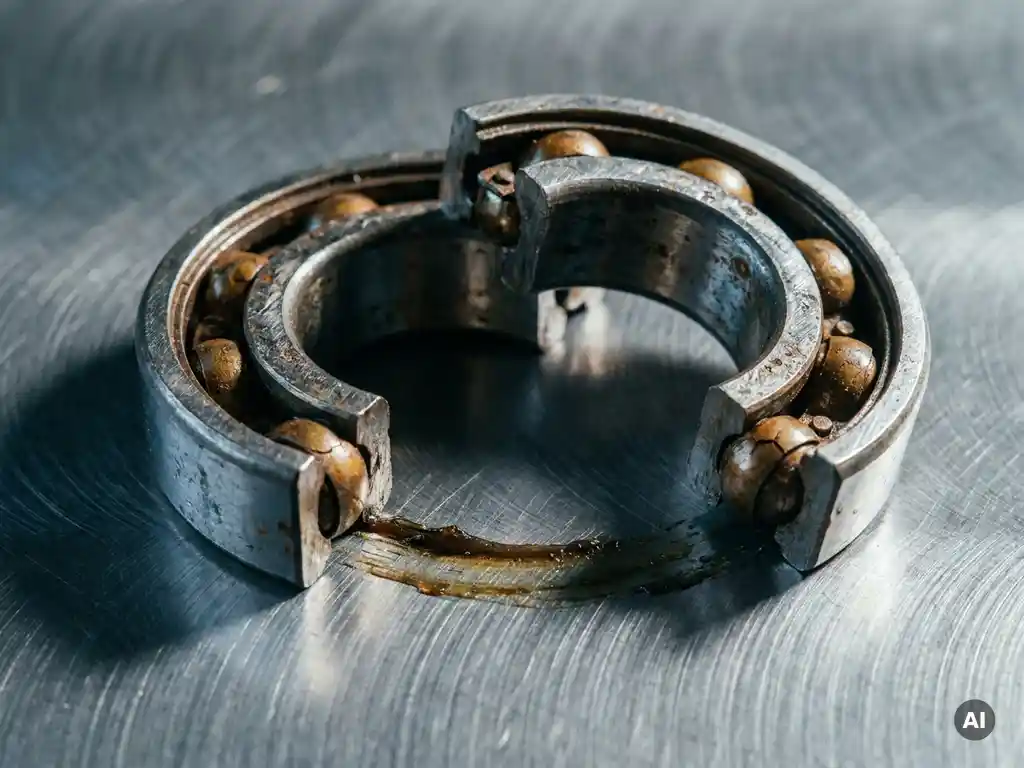
Ignoring early bearing failure signs leads to a predictable and costly escalation. What begins as a minor surface defect progresses through increasingly severe stages: spalling spreads across the race, rolling elements begin to fragment, the bearing cage deforms, and eventually the bearing seizes or disintegrates entirely. The time between the first detectable symptoms and complete functional failure — the PF curve interval — varies by application, but once advanced symptoms are present, the remaining service life is often measured in days rather than weeks.
The consequences extend well beyond the bearing itself. A seized bearing can lock the shaft, causing sudden mechanical shock that damages couplings, gearboxes, and driven equipment in a single event. In high-speed applications, bearing disintegration can cause physical damage to the housing and surrounding structure. In pumping systems, a failed bearing can allow the shaft to deflect enough to damage mechanical seals, leading to process fluid leakage with environmental or safety implications.
From a cost perspective, the difference between acting on early warning signs and waiting for failure is substantial. A planned bearing replacement during a scheduled maintenance window involves the cost of the bearing, labor, and a short planned downtime. An unplanned failure adds emergency labor rates, expedited parts sourcing, extended downtime while the full extent of secondary damage is assessed, and the potential loss of production output. In critical processes, a single unplanned bearing failure can generate costs many times higher than the value of the bearing itself.
How Zytec helps prevent bearing failure in rotating equipment
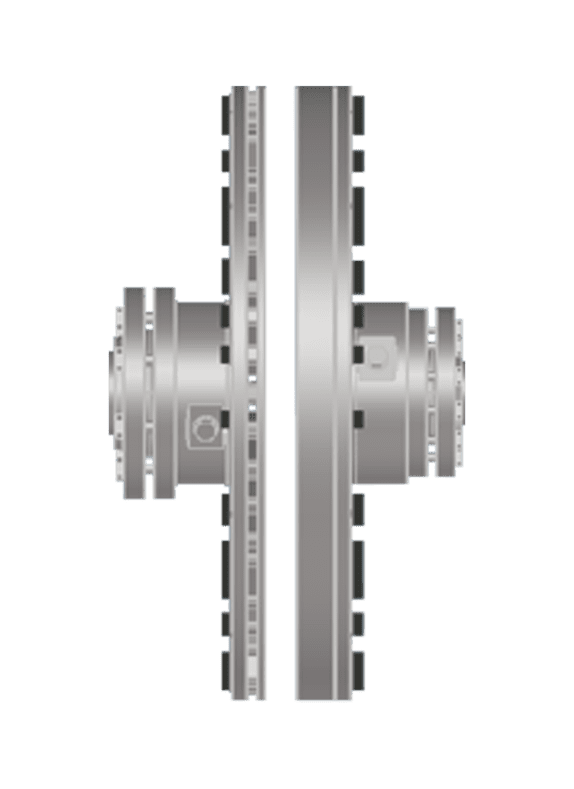
Zytec's non-contact magnetic drives address bearing failure at its root causes rather than at the symptom level. Because Zytec's drives transmit torque across an air gap using eddy current magnetic coupling, there is no physical contact between the motor and the driven load. This eliminates the misalignment forces that are responsible for the largest share of bearing wear in conventional drivetrains.
The practical benefits for bearing health are direct and measurable:
- No misalignment forces transmitted to bearings: Because the non-contact coupling does not mechanically connect the motor shaft to the driven shaft, operational misalignment caused by thermal expansion, pipe strain, and foundation movement never reaches the bearings as a load.
- No torsional oscillations or shock loads: Torque peaks and torsional vibration cannot propagate through the air gap, removing a key driver of dynamic bearing overload.
- Vibration reduction up to 80%: Lower vibration levels throughout the drivetrain mean bearings, seals, and connected equipment all operate under more stable conditions, extending their service life significantly.
- No coupling wear components to maintain: With no elastomers, no lubrication systems, and no friction elements in the coupling itself, the number of maintenance interventions near rotating equipment is reduced — and each avoided intervention removes a potential source of human error that could compromise bearing alignment or loading.
- Extended PF curve interval: By eliminating coupling-induced peak loads and vibration, the detectable degradation window before functional failure is extended, giving maintenance teams more time to plan and respond.
The result is rotating equipment that runs cooler, quieter, and more reliably — with bearing service life extended and unplanned downtime reduced. If your facility is dealing with recurring bearing failures, excessive maintenance costs, or unpredictable equipment shutdowns, Zytec's non-contact drives offer a proven, engineering-led solution worth evaluating.
Frequently Asked Questions
How often should we be monitoring bearings for early signs of failure?
Monitoring frequency should be matched to the criticality of the equipment and its failure history. For critical rotating machinery, continuous online vibration monitoring is the gold standard, providing real-time data without requiring manual rounds. For less critical assets, periodic manual measurements — typically monthly or quarterly — using handheld vibration analyzers or ultrasonic instruments are sufficient, provided that baseline data is available for comparison. Any equipment with a history of recurring bearing failures should be moved to a higher monitoring frequency immediately.
What tools do we actually need to get started with bearing condition monitoring?
A practical starting point for most facilities is a handheld vibration meter or data collector paired with an ultrasonic detection instrument — together, these cover the early-stage noise and vibration signatures that precede visible bearing damage. An infrared thermometer or thermal camera rounds out the basic toolkit by adding temperature trending capability. More advanced programs layer in permanently mounted sensors and condition monitoring software to automate data collection and trend analysis, but even the basic handheld approach delivers significant value over purely reactive maintenance.
Can a bearing appear to run fine and still be close to failure?
Yes — this is one of the most dangerous misconceptions in bearing maintenance. Bearings can carry subsurface fatigue cracks, early-stage spalling, or lubrication film breakdown without producing symptoms obvious to routine visual inspection or a quick manual check. Ultrasonic and vibration analysis tools specifically exist to detect these pre-symptomatic conditions. Relying solely on operator observation or temperature touch-checks means defects are typically only caught in the mid-to-late stages of the failure progression, significantly narrowing the window for a planned response.
How do we tell the difference between a bearing problem and a misalignment problem when diagnosing equipment?
Misalignment and bearing wear often present with overlapping symptoms — elevated vibration, heat, and noise — because misalignment is itself a primary driver of bearing damage. The key diagnostic distinction lies in the vibration signature: misalignment typically produces dominant energy at 1x and 2x shaft running speed in both radial and axial directions, while bearing defects produce energy at the specific bearing defect frequencies calculated from the bearing geometry. Thermal imaging can also help — misalignment tends to generate heat concentrated at the coupling, whereas bearing wear generates heat localized at the bearing housing. Addressing the root cause (misalignment) rather than just replacing the bearing is critical to preventing recurrence.
What are the most common mistakes maintenance teams make when replacing a failed bearing?
The most damaging mistake is reinstalling a new bearing into the same conditions that caused the original failure — without correcting misalignment, replacing contaminated lubricant, or investigating the root cause. Other frequent errors include incorrect fitting technique (using impact tools that transmit force through the rolling elements), improper lubricant quantity or type, and failing to re-establish baseline vibration measurements after the replacement. A new bearing installed under the same adverse conditions will typically fail faster than the original, and the pattern of repeated early failures is often the first signal that a systemic drivetrain issue has not been resolved.
Are certain types of industrial equipment more prone to bearing failure than others?
Equipment that runs continuously at high speeds, handles variable or shock loads, or operates in harsh environments with contamination risk carries a statistically higher bearing failure rate. Centrifugal pumps, fans, compressors, and conveyor drives are among the most frequently cited assets in bearing failure statistics, partly due to their prevalence and partly due to the operating conditions they face. Variable frequency drive (VFD)-controlled motors introduce an additional risk factor — electrical bearing currents — that is often underappreciated until fluting damage is found on inspection. Prioritizing condition monitoring resources toward these asset classes delivers the greatest return.
How significant is the energy efficiency impact of a bearing that is beginning to fail?
A degrading bearing increases the mechanical resistance within the drivetrain, which translates directly into higher motor current draw and increased energy consumption — often detectable through power monitoring before the bearing damage is severe enough to trigger vibration alarms. Studies on pump and fan systems have shown that drivetrain inefficiencies from worn bearings, misalignment, and coupling losses can account for several percentage points of excess energy consumption. In high-run-time applications, this energy penalty accumulates into a measurable operational cost that adds to the case for early intervention, well beyond the direct maintenance savings.