The most effective way to reduce downtime in manufacturing is to shift from reactive repairs to a systematic approach that addresses the root causes of equipment failure before they stop production. For most industrial facilities, that means combining better maintenance practices with technology that eliminates the mechanical failure modes responsible for the majority of unplanned stoppages. The sections below work through the most common questions plant managers and reliability engineers ask when building a downtime reduction strategy.
What are the most common causes of unplanned downtime in manufacturing?
The most common causes of unplanned downtime in manufacturing are mechanical equipment failures, misalignment of rotating machinery, bearing and seal degradation, electrical faults, and human error introduced during maintenance interventions. In facilities that rely heavily on rotating equipment, coupling-related failures and misalignment-induced wear account for a disproportionately large share of all unplanned stoppages.
Misalignment is consistently cited across the industry as responsible for a significant portion of rotating machinery failures. When a motor shaft and driven equipment shaft are even slightly out of alignment, the forces transmitted through the coupling generate excess load on bearings and seals. Those components wear faster, their failure intervals shorten, and the window between detectable degradation and functional failure narrows. Over time, a single misaligned installation can trigger a chain of secondary failures across the drivetrain.
Beyond misalignment, the other major contributors to manufacturing downtime include:
- Wear in mechanical couplings — elastomers, gear teeth, and friction elements degrade continuously and require periodic replacement
- Vibration and torsional shock — transmitted through rigid or semi-rigid couplings, accelerating wear on downstream components
- Electrical supply issues — voltage spikes, harmonic distortion, and phase imbalance affecting motor windings
- Human error during maintenance — incorrect bolt torque, imperfect re-alignment, and reassembly errors that introduce new failure modes each time a technician works on the equipment
- Contamination and environmental factors — dust, moisture, and corrosive atmospheres degrading both mechanical and electronic components
Understanding which of these causes dominates in a specific facility is the starting point for any meaningful downtime prevention strategy.
How much does manufacturing downtime actually cost?
Manufacturing downtime costs extend far beyond the immediate loss of production output. The total cost of a single unplanned stoppage includes lost production value, labor for emergency repairs, expedited spare parts, contractor fees, permit-to-work administration, and the risk premium associated with non-routine maintenance work on live or recently energized equipment. In asset-intensive industries, these secondary costs frequently exceed the direct repair cost by a wide margin.
The cost picture becomes clearer when you account for the full chain of consequences. A coupling failure on a critical pump, for example, triggers lockout and tagout procedures, disassembly, sourcing of replacement parts, precision re-alignment with laser equipment, reassembly, re-checks after thermal growth, and a full recommissioning sequence before the line restarts. Each of those steps carries a time cost, a labor cost, and a probability of introducing a new error that shortens the next mean time between failures.
From a total cost of ownership perspective, the purchase price of any rotating equipment component is typically the smallest element in the lifecycle cost equation. The dominant cost drivers are the recurring consequences of failures and the maintenance interventions required to prevent them. For facilities where misalignment and coupling wear drive a significant share of rotating equipment maintenance spend, the cumulative OPEX impact over an asset's operational life is substantial. This is why procurement decisions based purely on unit price often produce the worst long-term financial outcomes.
What is the difference between reactive, preventive, and predictive maintenance?
Reactive maintenance means fixing equipment after it fails. Preventive maintenance means servicing equipment on a fixed schedule regardless of its actual condition. Predictive maintenance means monitoring equipment condition in real time and intervening only when data indicates a failure is approaching. Each approach represents a different relationship between maintenance cost and equipment availability, and the right mix depends on the criticality of the asset and the cost of failure.
Reactive maintenance
Reactive maintenance has the lowest planned cost but the highest unplanned cost. When a critical asset fails without warning, the disruption to production, the urgency premium on spare parts, and the extended downtime while repairs are organized typically far exceed what a structured maintenance program would have cost. For non-critical assets with low failure consequences, reactive maintenance can be a rational choice. For rotating equipment central to continuous production, it is rarely defensible.
Preventive maintenance
Preventive maintenance reduces the frequency of unexpected failures by replacing components on a fixed interval before they reach end of life. The limitation is that it replaces components that may still have significant useful life remaining, and it introduces maintenance-induced failure risk every time a technician disassembles and reassembles equipment. Each intervention is a probabilistic event for error, and in rotating equipment, errors during reassembly are a leading cause of premature bearing and seal failure.
Predictive maintenance
Predictive maintenance extends the PF curve, which is the timeline from the point where degradation becomes detectable to the point of functional failure. By monitoring vibration signatures, temperature, oil analysis, and other condition indicators, maintenance teams can identify deteriorating components and schedule intervention at the optimal point, maximizing useful component life while avoiding unplanned failures. Predictive maintenance delivers the best balance of availability and maintenance cost for critical rotating equipment, but it requires investment in monitoring infrastructure and analytical capability.
How do mechanical coupling failures contribute to downtime?
Mechanical coupling failures contribute to manufacturing downtime both directly, through catastrophic failure that stops the drivetrain immediately, and indirectly, through the gradual degradation they impose on bearings, seals, and other downstream components. Because couplings are the mechanical interface between the motor and the driven equipment, any force, vibration, or misalignment transmitted through the coupling affects the entire drivetrain.
Conventional coupling types, including jaw, pin-and-bush, grid, gear, metallic disc, and fluid-flex designs, all contain wear elements that degrade over time. Elastomers harden and crack. Gear teeth wear under load. Lubrication degrades and must be replaced. Each of these wear mechanisms has an inspection interval, typically ranging from one month to twelve months depending on the coupling type and operating conditions. Each inspection creates a maintenance event, and each maintenance event carries the risk of re-introducing misalignment or assembly errors that accelerate the next failure cycle.
The indirect contribution to downtime is often larger than the direct one. When a coupling transmits torsional oscillations and vibration into the drivetrain, bearings and seals operate under peak loads that shorten their service life. The result is a facility where bearing replacements, seal failures, and shaft damage appear as the primary causes of downtime, when the underlying driver is the coupling behavior that imposed those loads in the first place. Addressing coupling performance is therefore one of the highest-leverage interventions available for reducing rotating equipment downtime across an entire installation.
Can non-contact magnetic drives eliminate downtime caused by rotating equipment?
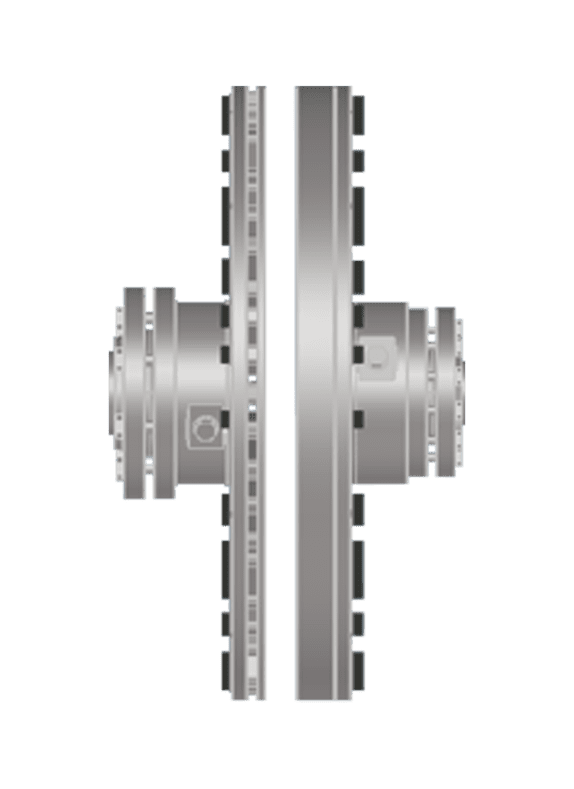
Non-contact magnetic drives can eliminate the majority of downtime causes associated with conventional mechanical couplings by removing all wear elements from the coupling itself and preventing the transmission of vibration, torsional shock, and misalignment forces into the drivetrain. Because torque is transmitted across an air gap using permanent magnets rather than mechanical contact, there are no elastomers, no gear teeth, no lubrication systems, and no friction elements to degrade.
The reliability implications are significant. A non-contact magnetic drive rated for a 20-plus year maintenance-free operational span does not require scheduled coupling inspections, periodic element replacement, or laser re-alignment. It tolerates both static installation misalignment and dynamic operational misalignment, caused by thermal expansion, pipe strain, and foundation movement, without generating forces on bearings or seals. Every component downstream operates under more stable load conditions, which extends bearing and seal service life and pushes the point of detectable degradation further into the future.
From a maintenance-induced failure perspective, eliminating scheduled coupling interventions structurally reduces the number of human error exposure events over the asset's life. Fewer technician hours near rotating equipment means fewer opportunities for incorrect bolt torque, imperfect alignment, or reassembly errors to introduce new failure modes. Safety risk is reduced by design rather than managed through procedure.
It is important to be precise about what non-contact drives address. They eliminate coupling-related and misalignment-driven downtime, which industry experience identifies as a major contributor to rotating machinery failures. They do not address unrelated failure modes such as motor winding faults, process upsets, or control system errors. For facilities where coupling and alignment issues are a primary downtime driver, the impact can be transformational. For facilities with well-managed coupling programs and downtime driven by other causes, the benefit profile will be different.
What is the fastest way to reduce downtime in an existing manufacturing facility?
The fastest way to reduce downtime in an existing manufacturing facility is to identify the highest-frequency failure modes on your most critical rotating equipment and address those root causes directly, rather than improving maintenance response speed. Faster repairs reduce the duration of each downtime event; eliminating the failure mode eliminates the event entirely. For most asset-intensive facilities, the highest-return starting point is rotating equipment reliability.
A practical sequence for rapid downtime reduction looks like this:
- Map your downtime causes — analyze maintenance records to identify which assets fail most frequently, what failure modes recur, and which stoppages have the highest production impact
- Prioritize rotating equipment — pumps, fans, compressors, and conveyors typically appear at the top of any downtime analysis in industrial facilities; focus reliability investment here first
- Address misalignment systematically — verify alignment on all critical installations and establish a process for checking dynamic misalignment under operating conditions, not just at installation
- Evaluate coupling technology — if coupling wear and alignment maintenance are recurring themes in your failure data, assess whether the coupling technology itself is the constraint
- Implement condition monitoring — deploy vibration and temperature monitoring on critical assets to extend the PF curve and enable planned intervention before failure
- Reduce maintenance-induced failures — standardize reassembly procedures, implement torque verification, and minimize the number of scheduled interventions that require drivetrain disassembly
Retrofit timelines matter in brownfield facilities. Technologies that can be installed without replacing existing motors, cabling, or control infrastructure deliver results faster and with less disruption to ongoing production. The goal is to reduce the number of failure events, not just to respond to them more efficiently.
How Zytec helps reduce downtime in manufacturing
Zytec develops non-contact magnetic drives specifically engineered to address the rotating equipment failure modes that cause the majority of unplanned downtime in industrial manufacturing. Their product portfolio, including the F-TORQ and A-TORQ non-contact drives, eliminates wear elements, misalignment forces, and vibration transmission from the drivetrain, targeting the root causes of coupling-related and alignment-driven stoppages rather than improving the speed of response to them.
Key ways Zytec's technology reduces manufacturing downtime:
- No wear components — no elastomers, gear teeth, lubrication, or friction elements means no scheduled coupling replacement and no coupling-induced bearing or seal overload
- Misalignment tolerance — tolerates up to 12 mm radial dynamic misalignment without transmitting forces into the drivetrain, eliminating alignment-induced failures and removing the laser alignment requirement at installation
- 20-plus year maintenance-free coupling life — structured reduction in maintenance interventions means fewer human error exposure events and fewer maintenance-induced failures over the asset's life
- Vibration reduction up to 80% — lower drivetrain vibration extends bearing and seal service life across the entire installation
- Energy savings up to 50% — the A-TORQ drive eliminates overcapacity in pump and fan applications, reducing operating costs alongside reliability improvements
- Short payback period — often under two years, driven by reduced maintenance spend, lower energy consumption, and higher production availability
Zytec's non-contact drives are designed as functional drop-in retrofits for conventional coupling installations, reusing existing motors and cabling to minimize installation time and disruption. For industrial organizations ready to move from managing downtime to eliminating its root causes, explore Zytec's non-contact drive solutions and find out how the technology applies to your specific rotating equipment challenges.
Frequently Asked Questions
How do I build a business case for investing in downtime reduction technology?
Start by quantifying your current downtime costs using actual maintenance records — calculate lost production value, emergency labor, expedited parts, and contractor fees for your highest-frequency failure events over the past 12–24 months. Once you have a credible total cost of unplanned downtime figure, compare it against the fully installed cost of the solution you're evaluating, including any productivity loss during retrofit. For most rotating equipment reliability investments, a payback period under two years is achievable when coupling wear, misalignment, and bearing failures are the dominant downtime drivers. Presenting the analysis in terms of OPEX reduction and production availability improvement — rather than unit component cost — is typically the most persuasive framing for capital approval.
How do I know if misalignment is actually causing failures in my facility, or if something else is the root cause?
The clearest indicators of misalignment-driven failure are recurring bearing and seal replacements on the same assets, shortened bearing service life compared to manufacturer ratings, elevated vibration signatures at 1x and 2x running frequency, and thermal hotspots at coupling and bearing locations detected during thermographic surveys. If your maintenance records show the same assets cycling through bearings and seals repeatedly — even after careful reassembly — misalignment transmitted through the coupling is a likely root cause rather than coincidental component quality issues. A laser alignment check performed under operating temperature conditions (not just at cold installation) will often reveal dynamic misalignment that static checks miss entirely.
What's the risk of introducing new failures when retrofitting a non-contact magnetic drive onto existing equipment?
The retrofit risk is generally lower than for conventional coupling replacements because non-contact magnetic drives are designed to reuse the existing motor, shaft, and cabling infrastructure — eliminating the need to disturb surrounding components. The primary installation consideration is ensuring correct axial gap setting between the magnetic rotor assemblies, which determines torque transmission capacity; this is a straightforward process with clear manufacturer specifications. Because the drive tolerates significant radial misalignment by design, the precision re-alignment step that introduces error risk in conventional coupling retrofits is not required. Commissioning checks are simpler, and the absence of mechanical contact means there is no run-in period during which premature wear could indicate an installation error.
Can predictive maintenance and non-contact drives be used together, or does one replace the need for the other?
They are complementary rather than competing strategies, and the combination delivers better outcomes than either approach alone. Non-contact magnetic drives eliminate the coupling itself as a source of wear, vibration, and misalignment-induced loading — removing a significant category of failure modes from the asset entirely. Predictive monitoring then focuses on the remaining failure modes: motor winding condition, process-side wear on pumps and fans, and any other degradation mechanisms that the drive does not address. With drivetrain vibration reduced by up to 80%, condition monitoring sensors also produce cleaner baseline signatures, making it easier to detect early-stage degradation in bearings and other downstream components before it progresses to functional failure.
How should we prioritize which assets to address first when starting a downtime reduction program?
Prioritize assets using a simple criticality matrix that scores each piece of rotating equipment on two dimensions: the production impact of a failure (lost throughput, safety risk, cascade effects on downstream equipment) and the historical frequency of failure or maintenance intervention. Assets that score high on both dimensions — typically critical pumps, main drive fans, and compressors on continuous production lines — should receive reliability investment first, as they offer the greatest return per dollar spent. Assets with high failure frequency but low production impact can be addressed in a second wave, and non-critical equipment with infrequent failures can remain on a reactive or basic preventive program without significantly affecting overall availability.
Does switching to a maintenance-free coupling technology create any compliance or inspection obligations we need to plan for?
Non-contact magnetic drives are mechanical power transmission components and do not introduce new regulatory obligations beyond those that apply to the rotating equipment installation as a whole — existing lockout/tagout, guarding, and machine safety requirements remain unchanged. From an internal audit and insurance perspective, it is worth documenting the elimination of scheduled coupling inspection intervals in your maintenance management system (CMMS) so that the absence of those work orders is recorded as a deliberate engineering decision rather than a compliance gap. Some facilities also choose to retain an annual visual inspection record for non-contact drives as a quality assurance step, even though no intervention is required, to maintain a clear maintenance history for asset lifecycle reporting.
What energy savings should we realistically expect, and how do they factor into the ROI calculation?
Energy savings depend heavily on the application and the degree of overcapacity in the existing installation. For pump and fan applications using the A-TORQ variable-speed non-contact drive, savings of up to 50% are achievable where the system has been running at fixed speed against a throttled valve or damper — a very common situation in facilities where pumps and fans were originally oversized for peak demand. For direct-drive applications where the primary benefit is reliability rather than speed control, energy savings are more modest and ROI is driven predominantly by reduced maintenance spend and higher production availability. When building your ROI model, calculate energy savings and downtime cost reduction separately so each benefit stream is defensible on its own, and the combined case is conservative rather than dependent on any single assumption.