MTTR, or mean time to repair, is calculated by dividing the total time spent on repairs by the number of repair events in a given period. It is one of the most widely used maintenance KPIs in industrial operations, giving teams a clear measure of how quickly they restore equipment to working condition after a failure.
For asset-intensive industries where rotating equipment runs continuously, MTTR directly affects production output, operational costs, and overall equipment effectiveness. This article walks through the MTTR formula, what counts as repair time, useful benchmarks, how MTTR relates to other maintenance metrics, and practical ways to reduce it.
What does MTTR actually measure?
MTTR measures the average time required to repair a piece of equipment and return it to full operational status after an unplanned failure. It captures the speed and efficiency of a maintenance team's response, not just the physical repair work itself. A lower MTTR means faster recovery from failures and less unplanned downtime.
The metric is most useful when tracked over time and across similar equipment types. A single repair event tells you little, but a consistent MTTR trend reveals whether your maintenance processes, spare parts availability, and team capabilities are improving or deteriorating.
It is important to understand that MTTR is an average. Individual repair events can vary significantly depending on the nature of the failure, the skill of the technician, and whether the right parts are available. Averaging across many events smooths out that variation and gives a more reliable picture of systemic performance.
What is the formula for calculating MTTR?
The MTTR formula is straightforward: divide the total repair time by the total number of repairs completed within the same measurement period.
MTTR = Total Repair Time / Number of Repairs
For example, if your maintenance team completed eight repairs during a month and the combined repair time across all events was 40 hours, your MTTR for that period is five hours. This means that, on average, it takes five hours from the point a failure is confirmed to the point the equipment is back in service.
The measurement period can be daily, weekly, monthly, or annual depending on how frequently failures occur and how granular you need the data. For high-criticality equipment that fails rarely, a longer measurement window produces a more statistically meaningful result. For equipment with frequent failures, shorter intervals can help you spot trends faster.
Consistency in how you define and record repair time is essential. If one technician starts the clock at failure detection and another starts it at the moment the wrench is picked up, your MTTR figures will not be comparable across shifts or sites.
What counts as repair time in an MTTR calculation?
Repair time in an MTTR calculation typically covers the full period from the moment a failure is confirmed to the moment the equipment is restored to operational status and verified as fit for service. This includes all activities within that window, not just the hands-on repair work.
In practice, the activities that contribute to total repair time include:
- Failure notification and diagnosis: The time from detecting the failure to identifying its root cause
- Permit-to-work and lockout/tagout administration: Safety procedures required before any work can begin
- Parts retrieval: Locating and collecting the necessary spare parts from stores or arranging emergency procurement
- Physical repair or replacement: The hands-on maintenance work, including disassembly, component replacement, and reassembly
- Alignment and calibration: Any precision work required after reassembly, such as laser alignment of rotating shafts
- Testing and recommissioning: Verifying that the equipment operates correctly before returning it to production
Some organizations choose to exclude logistical delays such as waiting for a contractor or waiting for parts to arrive from an external supplier, on the grounds that these are supply chain issues rather than maintenance performance issues. Others include them because those delays still represent downtime. The key is to define your scope clearly and apply it consistently across all recorded events.
What MTTR does not measure is the time between a failure occurring and it being detected. That gap is captured by a separate metric called mean time to detect, or MTTD.
What is a good MTTR benchmark for industrial equipment?
There is no single universal benchmark for MTTR because acceptable values vary significantly by industry, equipment criticality, and the consequences of downtime. However, for most industrial rotating equipment, an MTTR below four hours is generally considered strong performance, while values consistently above eight hours signal a need for process improvement.
Context matters more than absolute numbers. A pump in a non-critical cooling circuit with a standby unit available can tolerate a longer MTTR without production impact. A single-train compressor in a chemical process with no redundancy has a much lower tolerance. In those high-criticality applications, organizations often target MTTR values of two hours or less.
Several factors influence what benchmark is realistic for your operation:
- Equipment complexity: More complex machines with many interdependent components naturally take longer to diagnose and repair
- Spare parts availability: On-site spares dramatically reduce repair time compared to procuring parts after failure
- Maintenance team skill: Experienced technicians who know the equipment well resolve failures faster
- Documentation quality: Clear maintenance procedures reduce diagnostic time and minimize errors during reassembly
- Safety requirements: Industries with strict permit-to-work and isolation procedures have structurally longer MTTRs than less regulated environments
Rather than chasing an industry average, the most useful approach is to establish your own baseline, set an improvement target, and track progress over time.
What's the difference between MTTR, MTBF, and MTTF?
MTTR, MTBF, and MTTF are three distinct maintenance metrics that together describe the reliability and repairability of equipment. MTTR measures how long repairs take, MTBF measures how long equipment runs between failures, and MTTF measures the expected lifespan of equipment that is not repaired or replaced after failure.
MTTR: Mean Time to Repair
MTTR focuses on the maintenance response. It answers the question: when something fails, how quickly can we fix it? It is a measure of maintenance efficiency and process quality. A low MTTR reflects well-prepared teams, good spare parts management, and efficient procedures.
MTBF: Mean Time Between Failures
MTBF measures the average operating time between one failure and the next for repairable equipment. It is calculated by dividing total uptime by the number of failures in a period. A high MTBF indicates reliable equipment that fails infrequently. MTBF is a measure of equipment reliability rather than maintenance speed.
MTTF: Mean Time to Failure
MTTF applies to equipment that is not repaired after failure and is instead replaced. It represents the expected operating life before the first failure. MTTF is commonly used for components such as bearings, seals, and electronic parts where replacement rather than repair is the standard response.
In practice, MTTR and MTBF are used together to calculate overall equipment availability. The standard formula is: Availability = MTBF / (MTBF + MTTR). Improving either metric increases availability, but the levers are different. Improving MTBF requires more reliable equipment or better preventive maintenance. Improving MTTR requires faster, more efficient repair processes.
How can MTTR be reduced on rotating equipment?
Reducing MTTR on rotating equipment requires addressing every phase of the repair process, from faster failure detection through to quicker recommissioning. The most impactful improvements typically come from better preparation before failures occur, not from working faster during the repair itself.
Key strategies that consistently reduce MTTR include:
- Maintain on-site critical spare parts: Waiting for parts after a failure is one of the largest contributors to extended downtime. Stocking bearings, seals, and other high-wear components eliminates that wait entirely.
- Standardize repair procedures: Written, step-by-step procedures reduce diagnostic time and prevent errors during reassembly that would require rework.
- Invest in condition monitoring: Vibration sensors, temperature monitoring, and oil analysis detect degradation early, giving maintenance teams time to plan repairs during scheduled windows rather than responding reactively.
- Reduce alignment time: Laser alignment of rotating shafts is one of the most time-consuming steps in any coupling replacement or motor swap. Equipment designs that reduce or eliminate this requirement directly shorten repair duration.
- Streamline permit-to-work processes: Administrative delays before work can begin add hours to every repair. Reviewing and simplifying isolation and permit procedures without compromising safety can recover significant time.
- Train maintenance teams regularly: Technicians who are familiar with specific equipment models work faster and make fewer errors. Structured training programs, including practical simulation, build that familiarity before a failure occurs.
Reducing the frequency and complexity of repairs is equally important. Equipment that requires less intervention and is simpler to reassemble has a structurally lower MTTR regardless of how well the maintenance team performs.
How Zytec Non-Contact Drives Help Reduce MTTR
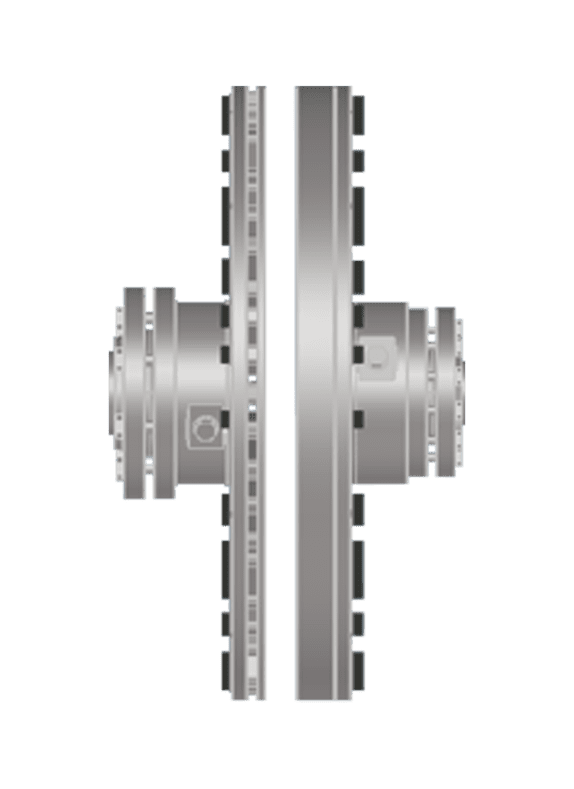
For industrial operations running pumps, fans, compressors, and other rotating equipment, Zytec's non-contact magnetic drives address MTTR at its root causes rather than just its symptoms. By eliminating the mechanical contact points that cause the majority of rotating equipment failures, they reduce both how often repairs are needed and how long those repairs take when they do occur.
Concrete ways Zytec technology reduces MTTR on rotating equipment:
- No alignment requirement: Because Zytec drives transmit torque magnetically across an air gap, laser alignment is not required during installation or after maintenance, removing one of the most time-consuming steps in any rotating equipment repair
- No wear components: With no elastomers, no lubrication systems, and no friction elements, there are no consumable parts to replace, which eliminates the spare parts retrieval delay that inflates MTTR
- Extended bearing and seal life: By removing coupling-induced vibration and torsional shock loads from the drivetrain, Zytec drives reduce the stress on bearings and seals, extending MTBF and reducing how often repair events occur in the first place
- Simpler recommissioning: Without precision alignment steps and torque-sensitive fastener sequences, returning equipment to service after any maintenance work is faster and less prone to error-driven rework
- Vibration reduction up to 80%: Lower vibration levels reduce the rate of degradation across the entire drivetrain, giving condition monitoring systems more warning time and enabling planned rather than emergency repairs
Zytec's products, including the F-TORQ and A-TORQ non-contact drives, are engineered for industries where unplanned downtime is costly and maintenance efficiency is a competitive advantage. If reducing MTTR and total maintenance costs on your rotating equipment is a priority, contact Zytec to discuss which non-contact drive solution fits your application.
Frequently Asked Questions
How do I get started tracking MTTR if my team has never measured it before?
Start by defining exactly what counts as the start and end of a repair event for your operation, then implement a simple logging process — even a spreadsheet — where technicians record the failure confirmation time and the equipment return-to-service time for every unplanned repair. Run this consistently for at least one to three months before drawing conclusions, since a meaningful baseline requires enough data points to smooth out outliers. Once you have that baseline, you can set realistic improvement targets and evaluate which phase of the repair process (diagnosis, parts retrieval, physical repair, or recommissioning) is consuming the most time.
What is the biggest mistake maintenance teams make when calculating MTTR?
The most common mistake is inconsistent clock-starting — different technicians or shifts beginning the timer at different points in the repair process, such as one team starting at failure detection and another starting when they physically arrive at the equipment. This makes your MTTR figures incomparable across shifts, sites, or time periods and masks real performance trends. Solve this by documenting a clear, written definition of what starts and stops the repair clock, training all technicians on it, and embedding those timestamp fields directly into your work order or CMMS so the process is standardized by default.
Should I track MTTR separately for different equipment types, or as a single site-wide number?
Tracking MTTR by equipment category — for example, centrifugal pumps, motors, compressors, and fans separately — is far more actionable than a single blended site average, because the drivers of long repair times differ significantly between equipment types. A high blended MTTR might be entirely driven by one problematic equipment class, which a single number would obscure. Start with a site-wide figure to establish overall performance, then segment by equipment type and criticality tier to identify where targeted improvements will have the greatest impact on production and cost.
How does MTTR relate to overall equipment effectiveness (OEE), and should I be tracking both?
MTTR directly affects the availability component of OEE, since every unplanned repair event reduces the percentage of scheduled time that equipment is actually running and producing. A lower MTTR means shorter downtime durations per failure event, which lifts availability and therefore OEE. You should track both: OEE gives you the high-level view of asset productivity, while MTTR tells you specifically how well your maintenance team recovers from failures — making it a leading indicator you can act on before OEE deteriorates further.
Can condition monitoring alone significantly reduce MTTR, or does it mainly help with MTBF?
Condition monitoring primarily improves MTBF by catching degradation early enough to schedule repairs before a catastrophic failure occurs — but it also has a meaningful impact on MTTR. When technicians receive early warning of a developing fault, they can pre-stage spare parts, schedule the right personnel, prepare work permits, and plan the repair sequence in advance, all of which compress the actual repair duration when the work is carried out. The difference between a reactive emergency repair and a planned repair on the same piece of equipment can easily be a factor of two or three in total repair time, even when the physical work is identical.
What if our MTTR is low but we're still experiencing significant production losses from downtime?
A low MTTR with high production losses usually points to a high failure frequency rather than a slow repair process — meaning your MTBF is the metric that needs attention, not your MTTR. In this scenario, the priority should shift toward reliability improvement: root cause analysis on repeat failures, a stronger preventive maintenance program, equipment upgrades, or design changes that reduce the inherent failure rate. Tracking both MTTR and MTBF together, and calculating your resulting availability using the standard formula, will show you clearly which lever will deliver the greater production benefit.
How do non-contact or alignment-free drive technologies actually show up in MTTR data over time?
The impact typically appears in two ways in your MTTR data: a reduction in the average repair duration for drivetrain-related events, because steps like laser alignment and torque-sensitive reassembly are eliminated, and a reduction in the frequency of bearing and seal replacements, which raises MTBF and means fewer repair events are logged in the first place. Teams that switch from traditional mechanical couplings to non-contact drives often find that what previously required four to six hours of precision alignment and verification work can be completed in a fraction of that time, and that downstream components such as pump bearings last significantly longer between interventions.