What counts as unplanned downtime in manufacturing?
Unplanned downtime in manufacturing is any period when production equipment stops operating unexpectedly, outside of scheduled maintenance windows or planned shutdowns. It is defined by its unscheduled nature: the stoppage was not anticipated, not budgeted for, and not built into the production plan. Even brief, recurring stops that collectively add up over a shift qualify as unplanned downtime.
The distinction between planned and unplanned downtime matters because they have very different cost profiles and management responses. Planned downtime, such as scheduled preventive maintenance, lubrication checks, or alignment inspections, can be minimized, batched, and timed to reduce production impact. Unplanned downtime cannot be managed in advance, which is precisely what makes it expensive.
In practice, unplanned downtime includes:
- Sudden mechanical failures in pumps, fans, compressors, or conveyors
- Bearing failures caused by misalignment or vibration
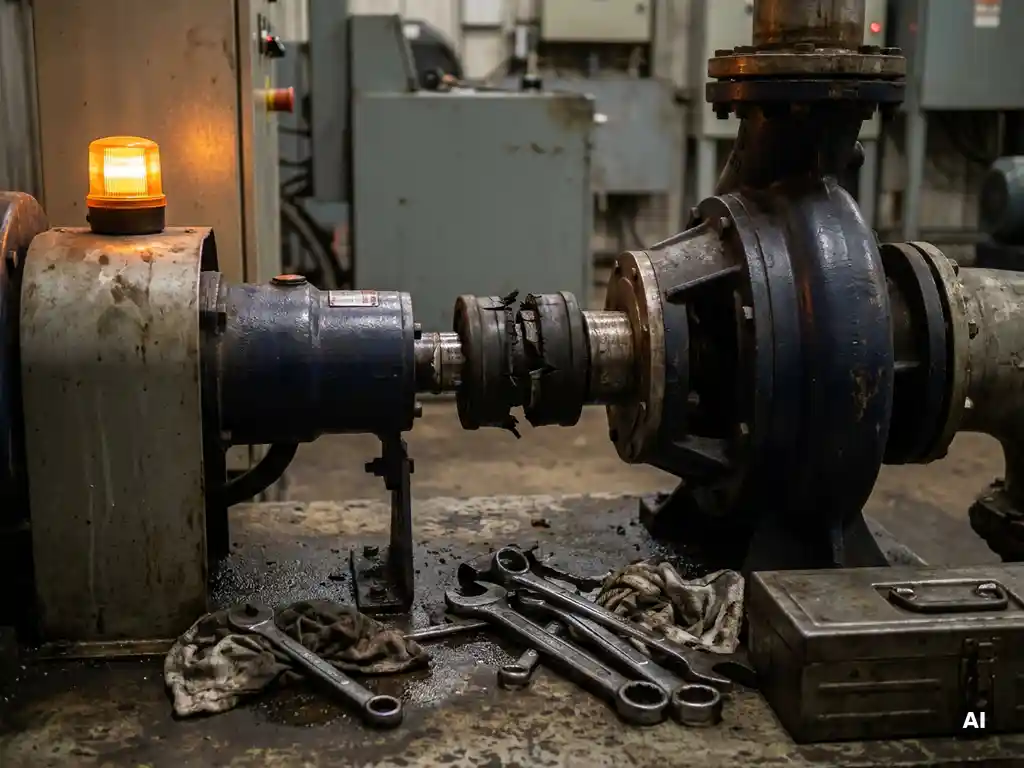
- Seal and coupling failures that force emergency shutdowns
- Electrical faults in drive systems
- Process upsets triggered by equipment instability
- Emergency repairs that require lockout/tagout and permit-to-work procedures
It is worth noting that some facilities also track micro-stoppages, short interruptions of under five minutes that individually seem trivial but collectively erode capacity. These are often excluded from formal downtime reporting but represent a real and measurable loss in overall equipment effectiveness.
What are the industry benchmarks for acceptable downtime?
There is no single universal benchmark for acceptable downtime, but the most widely used reference point is OEE. World-class OEE is generally considered to be 85% or higher, which allows for a combined downtime budget of roughly 15% across planned maintenance, changeovers, and unplanned failures. For unplanned downtime specifically, leading facilities typically target less than 5% of total available production time.
Industry benchmarks vary significantly by sector and asset type:
- Continuous process industries (chemical, oil and gas, pulp and paper): unplanned downtime targets are often below 2% of annual operating hours, because a single shutdown can affect an entire production train
- Water and wastewater utilities: pump availability targets frequently exceed 98%, with redundancy built in to cover planned maintenance windows
- HVAC and building services: fan and pump systems are expected to run continuously for years between interventions, with downtime measured in hours per year rather than percentage points
- Discrete manufacturing: OEE benchmarks of 65-85% are common, with unplanned downtime accounting for a significant share of losses in lower-performing facilities
- Mining and heavy industry: equipment availability targets of 90-95% are standard for critical assets, though actual performance often falls short
The key takeaway is that acceptable downtime is always context-dependent. What matters is whether your facility's downtime rate is trending in the right direction, whether root causes are understood, and whether the gap between current performance and the benchmark is being actively closed.
What causes most unplanned downtime in industrial plants?
The leading causes of unplanned downtime in industrial plants are mechanical failures in rotating equipment, most commonly driven by misalignment, vibration, bearing wear, and seal degradation. Industry experience consistently points to rotating machinery, including pumps, fans, compressors, and conveyors, as the primary source of unscheduled production losses in asset-intensive facilities.
Misalignment and vibration
Misalignment between the motor and the driven equipment is widely cited as responsible for a substantial share of rotating machinery failures. When shaft centerlines are not precisely aligned, the resulting forces overload bearings and seals, accelerate wear, and generate vibration that propagates through the entire drivetrain. Even small misalignment that develops over time through thermal growth, foundation settlement, or pipe strain can significantly shorten component life. Vibration amplifies this effect, turning gradual wear into sudden failure.
Maintenance-induced failures
A significant but often underappreciated cause of unplanned downtime is failure that originates during maintenance itself. Every time a coupling is disassembled, realigned, and reassembled, there is a risk of introducing new misalignment, incorrect torque, or damage to seals and bearings. Permit-to-work administration, lockout/tagout procedures, and the coordination of contractors add complexity and exposure time. Research in reliability engineering consistently shows that maintenance interventions on rotating equipment carry a measurable failure risk in the hours and days immediately following the work.
Aging and wear in conventional drive components
Conventional mechanical couplings rely on physical contact between components, which means wear is inherent and progressive. Elastomeric elements, gear teeth, and pin-and-bush assemblies all degrade over time and require periodic replacement. When replacement is delayed, or when a component fails between inspection intervals, the result is unplanned downtime. The same applies to lubrication-dependent couplings: contamination or lubrication failure can trigger rapid, unpredictable degradation.
How much does industrial downtime actually cost?
The cost of unplanned downtime in industrial manufacturing is almost always higher than facilities initially estimate, because the visible repair cost is only a fraction of the total. The full cost includes lost production, emergency labor, expedited spare parts, contractor coordination, regulatory compliance for re-entry, and the downstream effects on scheduling and customer commitments.
The cost structure of a single unplanned downtime event typically includes:
- Lost production value: the revenue or throughput lost while the line is stopped, which in continuous process industries can run into tens of thousands of euros per hour
- Emergency maintenance labor: often at premium rates, with overtime and contractor callout charges
- Spare parts and expediting: emergency procurement frequently costs several times the standard price for the same component
- Permit-to-work and lockout/tagout administration: in regulated environments, compliance procedures add hours to every intervention
- Realignment and recommissioning: precision laser alignment, soft-foot correction, and post-repair verification all require skilled time
- Cascading equipment stress: sudden stops and restarts place abnormal loads on connected equipment, potentially triggering secondary failures
The total cost of ownership framework is the most useful lens for evaluating downtime costs. When the full lifecycle cost of repeated interventions is calculated across a multi-year period, the purchase price of any drive component or coupling becomes a minor line item compared to the accumulated cost of the downtime it causes or prevents.
When should high downtime be treated as a systemic problem?
High downtime should be treated as a systemic problem when the same equipment, equipment type, or failure mode recurs repeatedly without a lasting fix. A single failure event is an incident. Two or three failures from the same root cause within a 12-month period is a pattern. Patterns indicate that the underlying engineering, maintenance strategy, or equipment selection is mismatched with the operating conditions.
Specific signals that downtime has become systemic rather than incidental include:
- The same pump, fan, or compressor failing more than once per year
- Bearing replacements being performed on a reactive rather than predictive basis
- Alignment work being required after every maintenance intervention
- Vibration levels that return to elevated readings within weeks of a repair
- Maintenance budgets consistently exceeded due to unplanned work
- Production schedules routinely disrupted by equipment-related stoppages
From an asset management perspective aligned with ISO 55000 principles, systemic downtime signals a gap between the maintenance strategy and the actual failure behavior of the asset. The appropriate response is not to accelerate the same maintenance cycle, but to investigate whether the root cause lies in the coupling technology, the drive system, the installation quality, or the operating profile. Treating systemic downtime as a procurement or engineering decision, rather than a maintenance scheduling problem, is the shift that separates reactive facilities from high-availability ones.
How can rotating equipment downtime be reduced long-term?
Reducing rotating equipment downtime over the long term requires addressing root causes rather than accelerating reactive repairs. The most durable gains come from eliminating the physical failure mechanisms that generate most unplanned stoppages: misalignment, vibration, wear in contact components, and maintenance-induced damage. Technology choices, installation quality, and monitoring strategy all play a role.
Proven approaches to long-term downtime reduction include:
- Eliminating misalignment as a failure driver: selecting drive technologies that tolerate or eliminate misalignment removes one of the most common root causes of bearing and seal failure
- Reducing the frequency of maintenance interventions: every intervention is a risk event; fewer interventions mean fewer opportunities for human error and maintenance-induced failure
- Implementing condition monitoring: vibration analysis, temperature trending, and oil analysis allow failures to be predicted and addressed during planned windows rather than as emergencies
- Applying the cubic affinity law to fan and pump systems: matching equipment speed to actual process demand reduces mechanical stress and extends component life significantly
- Evaluating total cost of ownership at the design stage: specifying equipment based on lifecycle cost rather than purchase price leads to better long-term availability
The most significant long-term gains typically come from rethinking the coupling and drive technology at the heart of rotating equipment installations, since this is where misalignment, vibration, and wear originate.
How Zytec helps reduce unplanned downtime in rotating equipment
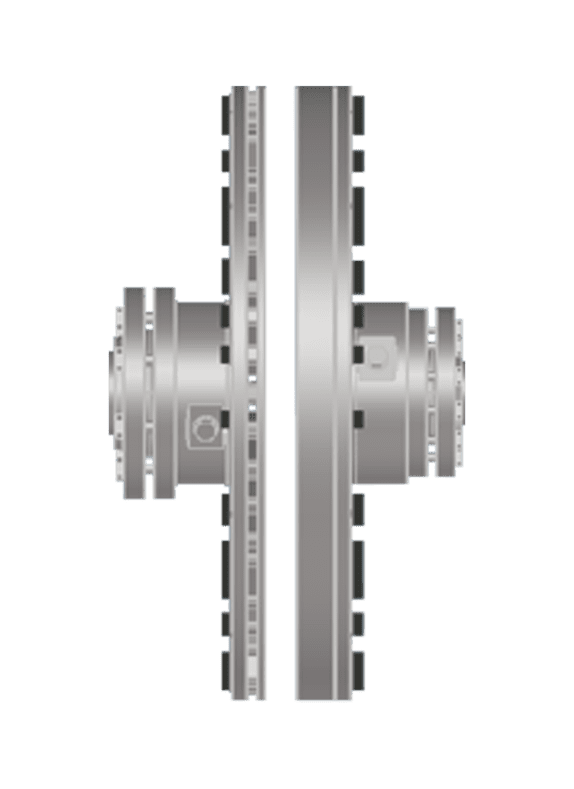
Zytec's non-contact drives address the root causes of unplanned downtime directly, by eliminating physical contact between the motor and the driven equipment. Because there is no mechanical connection, there is no wear, no misalignment-induced bearing overload, and no coupling element that degrades and requires replacement. The result is a structurally lower maintenance burden and a measurably higher equipment availability.
Key ways Zytec's technology reduces rotating equipment downtime include:
- No alignment requirement: the non-contact operating principle accommodates radial misalignment up to 12 mm dynamically, removing the most common trigger for bearing and seal failure
- Vibration reduction up to 80%: lower vibration levels extend the life of connected components throughout the drivetrain
- No wear consumables: no elastomeric elements, no lubrication, no periodic element replacement, and no coupling maintenance for the rated service life
- Soft-start capability: smooth torque transmission reduces mechanical shock on startup, protecting motors, gearboxes, and driven equipment
- Energy savings up to 50%: in pump and fan applications, intelligent speed control through the A-TORQ non-contact drive eliminates overcapacity and reduces operational stress
Facilities that have made the switch to Zytec non-contact drives report installations that were previously maintenance-intensive becoming completely maintenance-free for extended periods, with payback periods often under two years. If unplanned downtime is a recurring problem in your facility, contact Zytec to explore how non-contact drive technology can deliver lasting reliability improvements.
Frequently Asked Questions
How do I calculate our facility's current unplanned downtime rate to compare it against benchmarks?
To calculate your unplanned downtime rate, divide the total hours of unplanned stoppages in a given period by the total available production hours in that same period, then multiply by 100 to get a percentage. For example, if a machine is available for 2,000 hours per year and experiences 120 hours of unplanned stoppages, your unplanned downtime rate is 6%. Once you have this figure, compare it against the sector-specific benchmarks outlined above — if you're in continuous process manufacturing and running above 2%, or in discrete manufacturing with an OEE below 65%, you have a measurable gap worth addressing systematically.
What's the difference between a reliability-centered maintenance (RCM) approach and just increasing preventive maintenance frequency?
Increasing preventive maintenance frequency is a reactive response that assumes more intervention equals better reliability — but as the post explains, every maintenance intervention carries its own failure risk. Reliability-centered maintenance (RCM) takes the opposite approach: it analyzes the actual failure modes of each asset and prescribes only the maintenance tasks that meaningfully reduce failure probability for that specific operating context. The result is often fewer interventions overall, targeted at the right assets at the right time, which reduces both maintenance cost and maintenance-induced failures simultaneously.
How quickly can condition monitoring programs realistically detect problems before they cause unplanned downtime?
The lead time between a detectable anomaly and an actual failure varies significantly by failure mode and monitoring technology. Vibration analysis can detect early-stage bearing defects weeks or even months before failure in well-maintained programs, while thermal imaging can identify electrical faults days to weeks in advance. The practical benefit is that even a two-to-four-week warning window is typically enough to schedule a planned repair during a production gap, converting what would have been an emergency shutdown into a controlled intervention — which can reduce total repair cost by 50% or more compared to an unplanned event.
What are the most common mistakes facilities make when trying to reduce rotating equipment downtime?
The most common mistake is treating every failure as an isolated maintenance problem rather than investigating whether a systemic root cause — such as chronic misalignment, incorrect equipment selection, or inadequate installation quality — is driving repeated failures. A close second is focusing exclusively on reducing mean time to repair (MTTR) without addressing mean time between failures (MTBF): getting faster at fixing things is far less valuable than making failures happen less often. Facilities also frequently underestimate the cost of downtime by tracking only direct repair costs, which leads to underinvestment in preventive and predictive strategies that would deliver a strong return on investment.
At what point does it make financial sense to replace aging coupling or drive technology rather than continuing to maintain it?
The clearest financial signal is when the accumulated annual cost of maintenance interventions, spare parts, and associated downtime on a specific asset exceeds the annualized cost of replacing the drive technology with a more reliable alternative. A total cost of ownership (TCO) analysis over a three-to-five-year horizon typically makes this comparison straightforward. If a pump or fan coupling is being serviced two or more times per year, each intervention carrying labor, parts, alignment, and downtime costs, the TCO case for upgrading to a maintenance-free drive technology often shows a payback period of under two years — making replacement the economically rational choice.
Can non-contact drive technology be retrofitted onto existing rotating equipment, or does it require a full system redesign?
Non-contact drives such as Zytec's A-TORQ are designed to be retrofittable onto existing rotating equipment installations without requiring a full system redesign. In most cases, the non-contact drive replaces the conventional coupling between the motor and the driven equipment, fitting within the existing footprint and using the existing motor and driven shaft arrangement. This makes it practical to upgrade high-downtime assets on a priority basis without capital investment in new machinery, allowing facilities to target their worst-performing equipment first and demonstrate measurable reliability improvements before rolling out the technology more broadly.
How does the ISO 55000 asset management standard relate to downtime reduction in practice?
ISO 55000 provides a strategic framework for managing physical assets across their full lifecycle, with the goal of delivering value while controlling risk and cost. In the context of downtime reduction, the standard's most practical implication is that maintenance strategy decisions should be driven by a structured understanding of failure behavior, criticality, and lifecycle cost — not by habit or reactive pressure. Facilities aligned with ISO 55000 principles typically maintain asset registers with criticality ratings, use failure mode data to inform maintenance task selection, and evaluate equipment procurement decisions on total cost of ownership rather than purchase price alone, all of which directly support lower unplanned downtime rates over time.