What actually causes unplanned downtime in industrial operations?
Unplanned downtime in industrial operations is most commonly caused by mechanical coupling failures, misalignment of rotating equipment, bearing and seal degradation, and maintenance-induced errors. These are not random events. They are the predictable result of physical wear mechanisms that accumulate over time and eventually force a production stop at the worst possible moment.
Misalignment is one of the most significant and underestimated contributors. Industry experience consistently points to misalignment as being responsible for a large share of rotating machinery failures, and its effects are cumulative. Even when a machine is aligned correctly at installation, thermal expansion during operation, pipe strain, foundation movement, and seasonal temperature variation push shafts out of tolerance during normal running conditions. The coupling absorbs these deviations through elastic deformation or sliding contact, generating forces that propagate directly into bearings and seals. Over time, those components degrade faster than their rated lifespan suggests.
Maintenance interventions themselves introduce a second, often overlooked failure pathway. Every time a technician disassembles a rotating machine to replace a coupling element, perform laser alignment, or lubricate a component, there is a statistical probability of reassembly error. Incorrect bolt torque, imperfect alignment after re-installation, a missing fastener, or a disturbed seal can each trigger a failure within hours or days of the intervention. Studies in reliability engineering consistently identify maintenance-induced failures as a significant contributor to equipment problems in asset-intensive plants.
Other common contributors to unplanned downtime include:
- Wear of elastomeric coupling elements that degrade with temperature, age, and accumulated operating hours
- Torsional vibration and shock loads transmitted through rigid or semi-rigid couplings into gearboxes and shafts
- Lubrication failures in gear or grid couplings
- Spare parts unavailability extending what would otherwise be a short repair into a multi-day production loss
- Overload events where mechanical couplings transmit fault forces directly into the drivetrain rather than absorbing or limiting them
The purchase price of a coupling is the smallest element in the lifecycle cost equation. The dominant costs are the secondary consequences: lockout/tagout administration, disassembly and reassembly time, precision alignment procedures, contractor coordination, lost production, and the risk premium of non-routine maintenance work. Understanding these root causes is the first step toward eliminating them by design rather than managing them through procedures.
Can uptime ever be truly guaranteed in rotating equipment?
No mechanical system can offer an absolute guarantee of zero downtime, but rotating equipment reliability can be engineered to a point where unplanned stops become statistically improbable over multi-year operational spans. The distinction between guaranteed uptime and engineered high uptime is important: one is a contractual promise, the other is a measurable outcome of design decisions that remove failure mechanisms at their source.
Conventional rotating equipment reliability depends on how well wear is managed. Every mechanical coupling contains components that degrade: elastomers soften, gear teeth wear, lubrication degrades, and alignment drifts. Inspection intervals for competitive coupling technologies range from one month to twelve months, meaning the equipment is only as reliable as the last maintenance event and the next one. This creates a reliability ceiling that cannot be broken by better procedures alone.
The practical path to near-guaranteed industrial uptime is to eliminate the wear mechanisms entirely. When a coupling contains no elastomers, no lubrication systems, no gear teeth, no friction elements, and no wear components of any kind, its torque transmission characteristics do not degrade with age, temperature, or accumulated operating hours. The result is a device whose service life matches the full lifetime of the installation rather than the replacement interval of its weakest component.
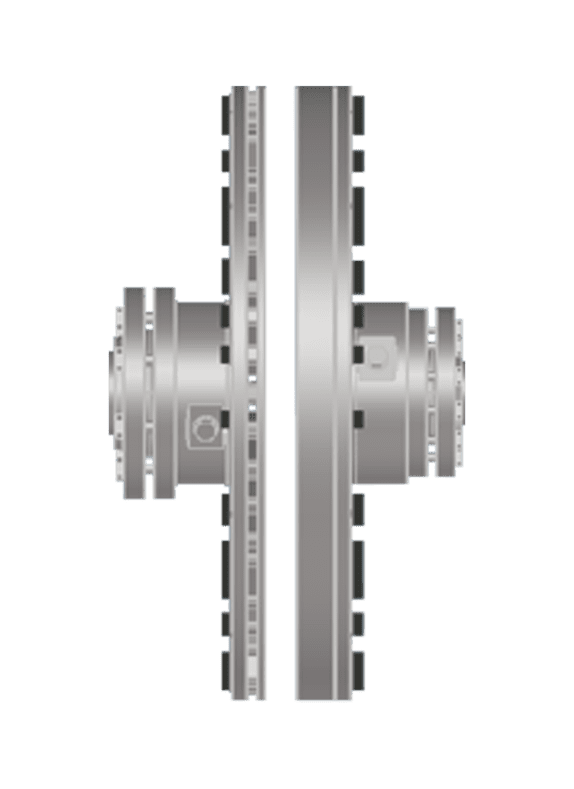
Non-contact magnetic drives represent this design philosophy in practice. Because torque is transmitted across an air gap using permanent magnets rather than physical contact, there is nothing to wear, nothing to lubricate, and no alignment-induced load to propagate into bearings and seals. The PF curve, the timeline from detectable degradation onset to functional failure, extends by a factor of approximately four compared to installations using conventional contact couplings. That is not a guarantee in the contractual sense, but it is a structural improvement in the probability of continuous operation that compounds over years and across an entire asset fleet.
How do non-contact magnetic drives reduce the risk of downtime?
Non-contact magnetic drives reduce the risk of downtime by eliminating the physical wear mechanisms that cause most rotating equipment failures. Because torque is transmitted across an air gap using powerful permanent magnets rather than mechanical contact, there are no coupling elements that degrade, no alignment forces that overload bearings, and no lubrication that can fail. Every component downstream operates under more stable load conditions.
The reliability improvement works through several reinforcing mechanisms. First, the coupling itself has a rated service life exceeding 20 years with no scheduled maintenance required. There are no elastomers to replace, no gear teeth to inspect, and no lubrication intervals to track. The only monitoring required is observation of air gap changes, which serve as an early indicator of system-level issues such as bearing degradation or foundation settlement rather than coupling-specific wear.
Second, dynamic misalignment, which occurs during operation due to thermal expansion, pipe strain, and foundation movement, is absorbed without generating forces in the drivetrain. A non-contact drive can accommodate up to 12 mm of radial dynamic misalignment and 11 mm of axial misalignment without transmitting any of that deviation as load into bearings or seals. This extends the operational life of every component connected to the drivetrain, not just the coupling itself.
Third, the elimination of scheduled coupling interventions reduces the number of human-error exposure events over the asset's life. Each maintenance intervention creates a probability event for error. By removing the need for periodic element replacement and re-alignment, non-contact drives like the F-TORQ structurally reduce that exposure rather than relying on procedural discipline to manage it.
Finally, non-contact drives provide inherent overload protection. Because there is no rigid mechanical link, torque peaks and fault conditions cannot propagate shock loads into the drivetrain. The coupling effectively decouples the motor from the driven equipment during overload events, protecting both sides without the need for additional protective devices.
What is the difference between preventive and condition-based maintenance?
Preventive maintenance follows a fixed schedule, replacing or servicing components at predetermined intervals regardless of their actual condition. Condition-based maintenance, by contrast, uses real-time or periodic monitoring data to trigger interventions only when equipment shows signs of approaching failure. The key difference is that preventive maintenance is time-driven while condition-based maintenance is state-driven.
Both approaches are responses to the same underlying problem: mechanical components wear out and need attention before they fail catastrophically. Preventive maintenance solves this by setting conservative intervals that ensure components are replaced before failure, but this comes at a cost. Components are often replaced while still functional, and the act of intervention itself introduces risk. Re-alignment after a coupling replacement, for example, must be performed precisely, and any deviation resets the degradation clock from a worse starting position than the original installation.
Condition-based maintenance extends component life by monitoring actual degradation indicators, such as vibration amplitude, temperature trends, oil particle counts, or acoustic emission signatures, and acting only when those indicators cross defined thresholds. This approach reduces unnecessary interventions and gives maintenance teams advance warning of failure, enabling planned rather than emergency repairs. The PF curve concept is central here: the earlier a degradation signal is detected, the longer the window between detection and failure, and the more options the team has for scheduling the repair.
Non-contact magnetic drive technology changes the maintenance calculus for the coupling itself. Because the coupling contains no wear components, neither preventive nor condition-based maintenance applies to the coupling element. The air gap serves as a passive indicator of system health: if it changes, something else in the drivetrain, a bearing, a foundation, or a connected pipe, is the cause. This shifts maintenance attention from the coupling to the components that actually need monitoring, making condition-based programs more targeted and effective across the whole system.
Which industries benefit most from high-uptime drive technology?
Industries that benefit most from high-uptime drive technology are those where rotating equipment is central to continuous production and where unplanned downtime carries severe operational, financial, or safety consequences. These include water and wastewater, chemical processing, oil and gas, pulp and paper, mining, HVAC, and maritime operations, where pumps, fans, compressors, and conveyors run continuously and any stop has immediate downstream effects.
In water and wastewater treatment, pumps operate around the clock with minimal redundancy in many installations. A coupling failure that forces a pump offline can interrupt treatment processes, trigger regulatory compliance issues, and require emergency contractor mobilization. High-uptime drive technology in this sector translates directly into service continuity and reduced emergency maintenance spend.
Chemical and oil and gas facilities add a safety dimension to the reliability equation. In hazardous area (ATEX) environments, conventional mechanical couplings introduce latent ignition risks through misalignment-induced frictional heating, elastomer wear hot spots, and unpredictable surface temperatures from degrading wear components. Non-contact drives certified for ATEX Zone 1 and Zone 2 eliminate these risks by design: no friction, no mechanical contact, no elastomers, no lubricants. The F-TORQ.EX series, for example, is certified under the constructional safety protection concept, meaning ignition sources are eliminated rather than contained.
Mining and pulp and paper operations face a different challenge: remote locations and long supply chains mean spare parts delays can extend a coupling failure into days or weeks of lost production. Equipment that does not require scheduled part replacement eliminates this exposure entirely.
HVAC and general industry applications benefit primarily from the energy efficiency dimension. Non-contact drives with variable speed capability allow pump and fan systems to operate at precisely the speed the process requires, following the cubic affinity law to reduce shaft power dramatically at partial load. Energy savings of up to 50% are achievable in these applications, with payback periods that often fall under two years.
How quickly can industrial facilities see results after switching to magnetic drives?
Industrial facilities switching to magnetic drives can see measurable results within days of commissioning. Energy savings are immediate because the drive begins operating at the correct load point from the first day. Vibration reduction, which can reach up to 80% compared to conventional coupling installations, is also visible within the first operating cycle. Maintenance cost reductions accumulate over months and years as scheduled interventions are eliminated.
The installation process itself is faster than many facilities expect. Non-contact drives do not require laser alignment, which is one of the most time-consuming steps in conventional coupling installation. Alignment can be set by simple eyeballing to within the coupling's generous tolerance range, eliminating the laser setup, soft-foot correction, shimming, and post-thermal-growth re-check sequence that conventional installations demand. This shortens commissioning time and reduces the technical skill requirement for the installation team.
The financial return timeline is equally direct. Because the largest cost drivers in rotating equipment maintenance are the secondary consequences of coupling-related failures rather than the coupling purchase price itself, removing those failure mechanisms produces cost savings that appear in the first maintenance cycle where an intervention would otherwise have been scheduled. For facilities with monthly or quarterly coupling inspection intervals, that first avoided intervention can arrive within weeks.
Over a longer horizon, the compounding effect becomes significant. Bearings and seals that no longer absorb misalignment-induced loads last longer, reducing replacement frequency across the entire drivetrain. Production availability increases as emergency stops become less frequent. Total cost of ownership, when calculated across a five to ten year asset life, reflects a step-change reduction compared to conventional coupling technologies, with solutions like the A-TORQ demonstrating payback periods well within two years in pump and fan applications. For industrial facilities ready to treat drive technology as a strategic asset decision rather than a commodity purchase, the results are both immediate and durable.
Frequently Asked Questions
How do I know if my current coupling setup is already causing hidden damage to bearings and seals?
The most reliable early indicators are elevated vibration signatures, abnormal bearing temperatures, and accelerated seal wear intervals — all of which can be present long before a visible coupling failure occurs. If your bearings are being replaced more frequently than their rated lifespan suggests, or if seals are leaking within months of replacement, misalignment-induced loading from the coupling is a likely root cause. A baseline vibration survey conducted immediately after your next scheduled alignment can reveal whether your drivetrain is operating within acceptable load parameters or silently accumulating damage between maintenance windows.
What should I look for when evaluating whether a non-contact magnetic drive is suitable for my application?
The key parameters to assess are torque range, shaft speed, required misalignment accommodation, and operating environment — including whether your installation falls within an ATEX-classified hazardous area. Non-contact drives are particularly well-suited to pump, fan, compressor, and conveyor applications running at continuous duty cycles where the cost of downtime is high relative to equipment investment. If your current coupling requires lubrication, scheduled element replacement, or frequent re-alignment, those are strong signals that a non-contact drive would deliver a measurable reliability and cost improvement in your specific application.
Can non-contact magnetic drives be retrofitted to existing equipment, or do they require a full drivetrain redesign?
In most cases, non-contact magnetic drives are designed as drop-in replacements that fit within the existing shaft centerline and footprint of a conventional coupling installation, without requiring motor or pump repositioning. The installation does not require laser alignment, which significantly reduces retrofit time and the technical complexity of the changeover. The main consideration is confirming that the drive's torque and speed ratings match the application requirements, and that adequate axial space exists between the motor and driven equipment shafts to accommodate the air gap assembly.
What happens if a process overload event occurs — will a non-contact magnetic drive protect my equipment automatically?
Yes, overload protection is an inherent characteristic of the non-contact design rather than an add-on feature. When torque demand exceeds the drive's rated capacity, the magnetic coupling slips across the air gap rather than transmitting the fault force into the drivetrain — effectively decoupling the motor from the driven load and preventing shock propagation into gearboxes, shafts, and bearings. Once the overload condition clears, the drive re-engages automatically without requiring manual reset or component replacement, unlike mechanical torque limiters or shear-pin devices that must be serviced after each event.
How does switching to a non-contact drive affect my existing maintenance program and CMMS scheduling?
The primary impact is a reduction in scheduled coupling-related work orders: element replacements, lubrication tasks, and post-maintenance re-alignment checks are removed from the maintenance calendar for each converted asset. In their place, a simple periodic air gap check is recommended as a passive system health indicator — if the gap changes, it signals a bearing or foundation issue upstream rather than coupling wear. This makes your CMMS more accurate and actionable, because the remaining scheduled tasks reflect genuine component degradation rather than conservative time-based intervals designed to compensate for coupling wear uncertainty.
Is there a minimum fleet size or production scale where non-contact magnetic drives start to make financial sense?
The financial case is strongest wherever a single unplanned downtime event carries significant cost — which applies to individual critical assets as much as to large fleets. Even a single pump or fan driving a bottleneck process can justify the switch based on one avoided emergency stop, particularly when lockout/tagout administration, contractor mobilization, and lost production are factored into the cost of that event. For facilities with multiple rotating assets on similar duty cycles, the compounding effect across the fleet — fewer bearing replacements, fewer seal failures, fewer emergency interventions — accelerates payback significantly and makes the business case straightforward to quantify.
What is the realistic service life of a non-contact magnetic drive, and what does end-of-life look like?
Non-contact magnetic drives using permanent magnets are rated for service lives exceeding 20 years under normal operating conditions, with no scheduled replacement of internal components required during that period. The permanent magnets themselves do not demagnetize under normal industrial operating temperatures, and because there is no mechanical contact, there is no wear surface to limit operational life. End-of-life for the drive unit typically coincides with the retirement of the connected equipment rather than coupling-specific degradation, which fundamentally changes the total cost of ownership calculation compared to conventional couplings that require element replacement every one to three years.