What are the most common causes of bearing failure?
The most common causes of bearing failure are inadequate lubrication, shaft misalignment, contamination from particles or moisture, and excessive vibration. Together, these four factors are responsible for the overwhelming majority of bearing damage in industrial rotating equipment. Overloading, improper installation, and electrical current passing through bearings are additional contributors that appear frequently in maintenance records.
Each cause damages bearings through a distinct mechanism, which is why identifying the root cause matters as much as replacing the failed component. A bearing replaced without addressing the underlying cause will typically fail again within a fraction of its rated service life. In industrial settings where pumps, fans, compressors, and conveyors run continuously, bearing failure carries significant consequences: unplanned downtime, production losses, and secondary damage to seals, shafts, and connected equipment.
The sections below address each major cause in turn, explaining the mechanism behind the damage and what it looks like in practice.
How does poor lubrication lead to bearing failure?
Poor lubrication causes bearing failure by allowing metal-to-metal contact between rolling elements and raceways. Without an adequate lubricant film, friction generates heat, accelerates surface wear, and eventually leads to spalling, seizure, or catastrophic collapse. Lubrication-related failures are widely recognized as one of the leading causes of premature bearing damage in industrial applications.
Lubrication problems fall into several distinct categories, each with its own damage signature:
- Insufficient lubrication: Too little grease or oil leaves bearing surfaces unprotected. Heat builds rapidly, and the bearing surface develops scoring and pitting.
- Excess lubrication: Overfilling a bearing housing is a common mistake. Excess grease churns, generates heat, and can degrade the lubricant faster than normal operation would.
- Wrong lubricant type: Using a grease with the wrong viscosity or base oil for the operating temperature and speed leads to film breakdown at the worst possible moment.
- Lubricant contamination: Water ingress, particulate matter, or chemical degradation breaks down the lubricant's protective properties even when the correct type and quantity are present.
- Relubrication intervals missed: Grease degrades over time. Bearings that are not relubricated on schedule gradually lose their protective film.
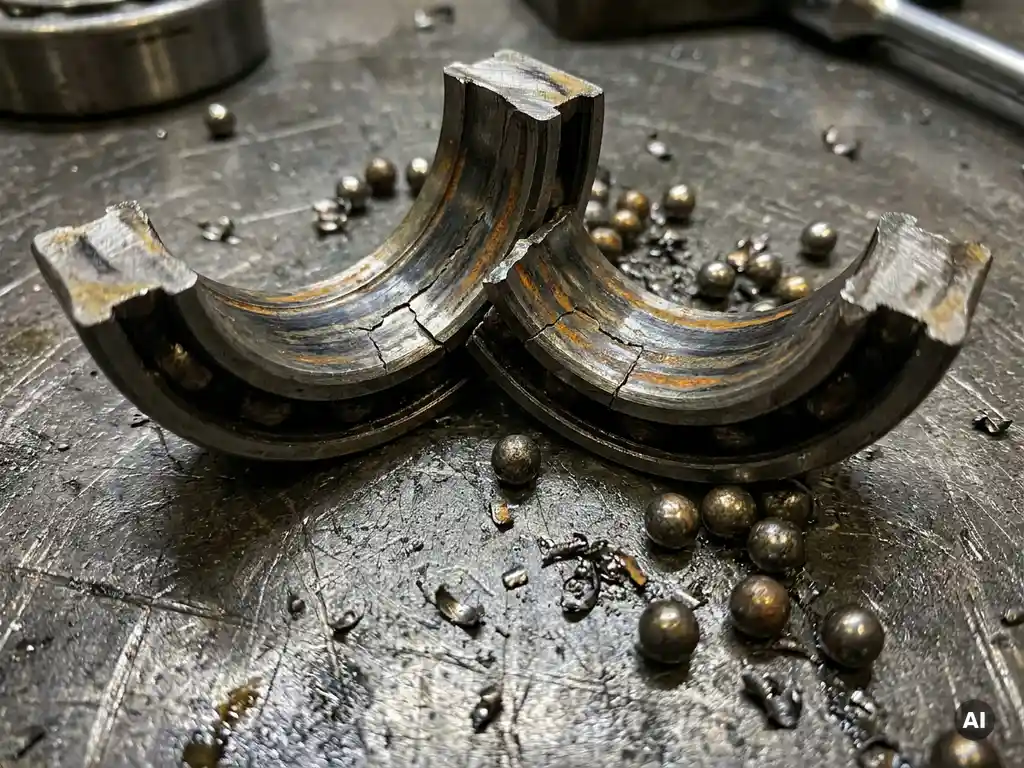
The practical result of lubrication failure is visible on the bearing surfaces: discoloration from heat, scoring on raceways, and smearing or flaking of the rolling element surfaces. In severe cases, the bearing cage fractures and the rolling elements scatter, causing immediate and total equipment failure.
Why does misalignment cause bearings to fail prematurely?
Misalignment causes premature bearing failure by imposing abnormal load distributions on rolling elements and raceways that the bearing was not designed to carry. Instead of load spreading evenly across the contact zone, misaligned shafts concentrate stress on narrow bands of the raceway, dramatically accelerating fatigue and wear.
There are two forms of misalignment that affect bearings differently:
Angular misalignment
Angular misalignment occurs when the centerlines of two connected shafts meet at an angle rather than running parallel. This forces the bearing to accommodate a rocking or tilting load with every revolution. The raceway develops uneven wear patterns, and the rolling elements are subjected to edge loading that exceeds their design limits. Fatigue cracks develop at the stressed edges and propagate inward, eventually causing spalling.
Parallel (offset) misalignment
Parallel misalignment occurs when two shaft centerlines are offset laterally but remain parallel. This generates a cyclical bending force that reverses direction with each shaft rotation. Bearings experience alternating high and low load zones, creating a pattern of fatigue damage that concentrates at specific points on the raceway corresponding to the direction of the offset.
What makes misalignment particularly damaging is that it is not a static problem. Even when a drivetrain is carefully aligned during installation, thermal expansion of motors and driven machines, pipe strain, foundation movement, and seasonal temperature variation cause shaft positions to shift during operation. The misalignment that develops under running conditions frequently exceeds the installation tolerance by a significant margin, imposing bearing loads that were never accounted for in the original design.
Industry sources consistently identify misalignment as responsible for a large proportion of rotating machinery failures, and its contribution to bearing and seal wear is one of the primary drivers of elevated maintenance costs in asset-intensive operations.
What role does contamination play in bearing damage?
Contamination causes bearing damage by introducing abrasive particles or corrosive substances into the bearing's internal clearances, where they score raceways, indent rolling elements, and degrade the lubricant film. Even microscopic particles can initiate surface fatigue that leads to spalling well before the bearing reaches its calculated service life.
The two main categories of contamination each damage bearings through different mechanisms:
Solid particle contamination
Dust, metal swarf, sand, and wear debris are the most common solid contaminants. Hard particles become embedded in the softer bearing surfaces or roll between the raceway and rolling elements, creating indentations. Each indentation acts as a stress concentration point where fatigue cracks can initiate. Over time, the raceway develops a rough, pitted surface that accelerates wear across the entire bearing. Fine particles that are smaller than the lubricant film thickness are particularly insidious because they are not filtered out but remain suspended in the lubricant, continuously abrading contact surfaces.
Moisture and chemical contamination
Water ingress is one of the most destructive forms of contamination because it attacks bearings on multiple fronts simultaneously. Moisture displaces the lubricant film, promotes hydrogen embrittlement of the steel surface, and causes corrosion that pits the raceway. Chemical contamination from process fluids, cleaning agents, or degraded lubricants introduces acidic or reactive compounds that corrode bearing surfaces and break down the lubricant's protective additives.
In industrial environments, contamination risk is highest during maintenance interventions, when bearings are exposed during disassembly and reassembly, and in applications where process fluids or environmental conditions make seal integrity difficult to maintain. Proper sealing, correct storage of replacement bearings, and clean assembly practices are the primary defenses against contamination-induced failure.
How can vibration both cause and signal bearing failure?
Vibration both causes and signals bearing failure because it operates as a self-reinforcing cycle: external vibration accelerates bearing wear, and bearing wear generates its own distinctive vibration signature that worsens as damage progresses. This bidirectional relationship makes vibration one of the most important parameters to monitor in rotating equipment.
As a cause of bearing damage, vibration introduces dynamic loads that cycle at frequencies determined by the rotating speed and bearing geometry. When vibration levels exceed the bearing's design tolerance, rolling elements and raceways experience repeated impact-style loading. In stationary or lightly loaded bearings, vibration can cause a specific failure mode called false brinelling: fretting wear that creates shallow indentations at the ball or roller pitch spacing, even without full rotation. This is common in equipment that is stored, transported, or subjected to external vibration from adjacent machinery while idle.
As a signal of bearing damage, vibration changes in characteristic ways depending on the failure stage. Early-stage damage produces high-frequency signals that are detectable with vibration analysis equipment before any audible noise or performance degradation appears. As damage progresses, vibration amplitude increases and the frequency signature broadens. Advanced damage produces the irregular, broadband vibration that is audible as roughness or rumbling and visible as increased amplitude across the frequency spectrum.
This progression is the basis for condition monitoring programs that use vibration analysis to detect bearing deterioration early, while there is still time to plan a controlled replacement rather than respond to an unplanned breakdown. The interval between detectable deterioration and functional failure is a critical window for maintenance planning, and anything that compresses that window increases operational risk.
How can bearing failure be prevented in industrial applications?
Bearing failure in industrial applications is prevented through a combination of correct lubrication practice, precision alignment, effective contamination control, vibration monitoring, and addressing the root causes of abnormal loads before they damage the bearing. No single measure is sufficient on its own; effective prevention requires all of these elements working together.
The most impactful preventive actions are:
- Lubrication management: Use the correct lubricant type and quantity for the operating conditions, maintain relubrication schedules, and monitor lubricant condition to detect contamination or degradation early.
- Precision alignment: Align shafts carefully at installation and account for thermal growth and dynamic conditions during operation. Verify alignment after any maintenance intervention that involves disassembly.
- Contamination control: Maintain effective sealing, store replacement bearings in clean, dry conditions, and follow clean assembly procedures to avoid introducing contaminants during installation.
- Vibration monitoring: Implement regular vibration measurements or continuous condition monitoring to detect early-stage bearing damage before it progresses to failure.
- Load management: Ensure bearings are correctly sized for the actual operating loads, including dynamic and shock loads, and avoid operating equipment outside its design envelope.
- Controlled maintenance practices: Every disassembly and reassembly event introduces the risk of misalignment, contamination, and incorrect reassembly. Reducing the frequency of maintenance interventions directly reduces the probability of maintenance-induced bearing failure.
A particularly important and often underappreciated prevention strategy is reducing the transmission of abnormal forces into the drivetrain. Misalignment-induced loads, torsional vibration, and shock loads from the coupling all reach the bearing and accelerate its wear. Drivetrain design decisions made upstream of the bearing directly affect how long the bearing lasts.
How Zytec helps prevent bearing failure
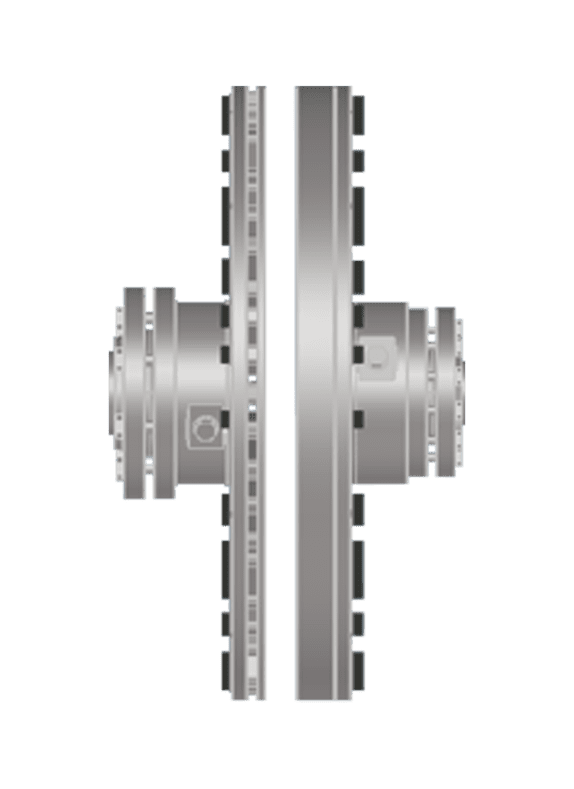
Zytec's non-contact drives address bearing failure at the source by eliminating the drivetrain forces that cause premature bearing wear. Rather than managing the symptoms of misalignment and vibration, Zytec's technology removes these failure mechanisms by design. For industrial operations running pumps, fans, compressors, and other rotating equipment, the practical benefits are concrete and measurable:
- Misalignment forces eliminated: Because Zytec's non-contact coupling transmits torque across an air gap using eddy current magnetic technology, there is no physical contact between the motor and driven shaft. Misalignment forces that would otherwise load bearings and seals are structurally eliminated rather than merely accommodated.
- Vibration reduced by up to 80%: Without coupling-induced torsional oscillations and shock loads entering the drivetrain, bearings, seals, and connected equipment operate under significantly more stable load conditions.
- No coupling wear components: The non-contact coupling contains no elastomers, no lubrication systems, no gear teeth, and no friction elements. This means no coupling-related debris or degradation products can contaminate the drivetrain environment.
- Extended bearing service life: By removing the primary drivers of premature bearing fatigue, the interval between bearing replacements extends significantly, reducing both maintenance costs and exposure risk during interventions.
- Energy savings up to 50%: More stable drivetrain operation translates directly into lower energy consumption, with payback periods often under two years.
If your operation is dealing with recurring bearing failures, high maintenance frequency, or unplanned downtime on rotating equipment, Zytec's non-contact drive technology offers a proven path to more reliable, lower-cost operation. Contact Zytec to discuss your specific application and find out how non-contact drive technology can extend bearing life and reduce total cost of ownership in your plant.
Frequently Asked Questions
How do I know which cause of bearing failure is responsible for my specific situation?
The most reliable way to identify the root cause is through a careful visual inspection of the failed bearing combined with a review of the operating conditions. Each failure mode leaves a distinct signature: heat discoloration and scoring point to lubrication issues, uneven or edge-concentrated raceway wear suggests misalignment, pitting and indentations indicate contamination, and evenly spaced indentations at ball pitch spacing are characteristic of vibration-induced false brinelling. If you have access to vibration data or lubricant analysis records leading up to the failure, these can confirm or narrow down the cause before you commit to a corrective action.
What is the most common mistake maintenance teams make when replacing a failed bearing?
The most common mistake is replacing the bearing without identifying and correcting the root cause of the failure. A new bearing installed into the same conditions — whether that means inadequate lubrication, a misaligned shaft, a contaminated housing, or excessive vibration — will typically fail again in a fraction of its rated service life. Before fitting a replacement, always inspect the housing, shaft, seals, and alignment, and review the lubrication schedule to ensure the conditions that caused the original failure have actually been addressed.
How often should bearings be relubricated, and how do I determine the right interval?
Relubrication intervals depend on bearing size, speed, operating temperature, and the environment the equipment runs in. Most bearing manufacturers provide relubrication interval formulas or lookup tables based on these parameters, and these should be your starting point. In practice, high-temperature, high-speed, or contaminated environments require shorter intervals than the standard calculation suggests, so it is worth validating calculated intervals against actual lubricant condition checks in the early stages of a new application. Automated lubrication systems can help maintain consistent intervals and quantities, particularly on equipment that is difficult to access regularly.
Can misalignment develop after installation even if the initial alignment was done correctly?
Yes, and this is one of the most frequently overlooked contributors to premature bearing wear. Thermal expansion of motors, driven machines, and their foundations causes shaft positions to shift significantly between cold startup and normal operating temperature — a phenomenon known as thermal growth. Pipe strain, foundation settlement, and even seasonal temperature variation can introduce additional misalignment over time. For critical equipment, it is good practice to verify alignment under actual operating conditions or to use thermal growth compensation during the initial alignment procedure, rather than relying solely on cold alignment measurements.
What are the best practices for storing replacement bearings to prevent contamination before installation?
Replacement bearings should be stored in their original, sealed packaging in a clean, dry environment with stable temperature and humidity. Bearings should never be stored directly on concrete floors or near sources of vibration, as even stationary vibration can cause false brinelling in an unloaded bearing. Only remove the packaging immediately before installation, and handle bearings with clean, dry gloves to prevent moisture and skin oils from reaching the surfaces. Using clean, dedicated tools during installation and avoiding any contact between the bearing and shop-floor contaminants are equally important steps that are often skipped under time pressure.
At what point in the bearing damage progression should I plan a replacement?
Ideally, replacement should be planned during the early-stage deterioration window, when vibration analysis has detected a developing fault but before audible noise, heat, or performance degradation appears. At this stage, the damage is limited to the bearing itself, secondary equipment such as seals, shafts, and housings is still intact, and the replacement can be scheduled during planned downtime rather than forced by an unexpected breakdown. Waiting until the bearing is audibly rough or running hot significantly increases the risk of secondary damage and compresses the time available to source parts and organize the repair.
Is vibration monitoring worth implementing for smaller or less critical rotating equipment, or is it mainly for large assets?
Vibration monitoring is worth considering for any equipment whose failure would cause unplanned downtime, production loss, or a safety risk — regardless of asset size. While large compressors and critical pumps are the most common starting point, smaller fans, conveyors, and auxiliary pumps can cause significant disruption if they fail unexpectedly. Low-cost wireless vibration sensors have made condition monitoring accessible for a much broader range of equipment than was practical a decade ago, and even a basic trending program that flags unusual changes in vibration amplitude can provide meaningful early warning without requiring a full-scale condition monitoring infrastructure.