The average cost of downtime in industrial manufacturing ranges from tens of thousands to hundreds of thousands of euros or dollars per hour, depending on the industry, plant size, and the nature of the equipment involved. For large-scale operations in sectors such as oil and gas, automotive, or chemical processing, a single hour of unplanned downtime can cost more than the annual salary of an entire maintenance team. The sections below break down how downtime costs are calculated, which industries are hardest hit, and what manufacturers can do to reduce exposure.
How much does industrial downtime cost per hour?
Industrial downtime costs per hour vary widely, but industry experience consistently places the figure for mid-to-large manufacturing facilities between €10,000 and €250,000 per hour of lost production. In highly capital-intensive sectors such as oil and gas refining or continuous process manufacturing, costs can exceed €500,000 per hour when all direct and indirect losses are counted together.
These figures reflect more than just lost output. Every hour a production line stands still, a facility absorbs the full weight of fixed costs — labor, energy overhead, lease obligations, and depreciation — without generating any revenue to offset them. Add in the cost of emergency labor, expedited spare parts, and potential contractual penalties for missed delivery commitments, and the per-hour figure climbs fast.
For rotating equipment specifically, the downtime cost per hour is often the single largest line item in a life-cycle cost calculation. A pump or fan failure that takes a critical process offline for even four to six hours can represent a financial impact that dwarfs the entire annual maintenance budget for that asset.
What factors determine the total cost of downtime?
The total cost of downtime is determined by four primary factors: lost production revenue, labor and contractor costs, spare parts and logistics expenses, and indirect costs such as contractual penalties, customer attrition, and regulatory consequences. No two downtime events carry exactly the same cost profile, but these categories consistently account for the bulk of the financial impact.
Direct production losses
The most immediate cost is lost throughput. Every unit not produced during a downtime event represents revenue that cannot be recovered. In continuous process industries — chemical plants, water treatment facilities, paper mills — production cannot simply be "made up" later because the process runs at capacity. The revenue loss is permanent.
Labor, parts, and logistics
Unplanned downtime triggers a cascade of secondary costs. Maintenance teams are pulled from scheduled work, often at overtime rates. External contractors may need to be mobilized on short notice, carrying significant call-out fees. Spare parts that are not held in inventory must be sourced urgently, frequently at premium prices with expedited freight charges. In some facilities, a single unplanned intervention on rotating equipment involves lockout/tagout administration, precision laser alignment, and multiple re-checks after thermal stabilization — all of which consume hours before the machine even restarts.
Indirect and reputational costs
Beyond the immediate financial hit, downtime carries longer-term costs that are harder to quantify but equally real. Missed delivery commitments can trigger contractual penalties. Repeated reliability failures erode customer confidence. Regulatory bodies in sectors such as water, chemical, and oil and gas may require incident reporting, which adds administrative burden and potential compliance risk. These indirect costs frequently exceed the direct production loss when calculated across a full fiscal year.
What is the difference between planned and unplanned downtime costs?
Planned downtime costs are predictable, budgeted, and typically far lower than unplanned downtime costs because maintenance teams can schedule work during low-demand periods, pre-order parts, and minimize disruption. Unplanned downtime costs are unpredictable by definition, occur at the worst possible times, and carry significant premium costs for emergency labor, expedited logistics, and lost production that cannot be recovered.
The cost difference between planned and unplanned downtime for the same repair task can be substantial. A scheduled coupling replacement carried out during a planned maintenance window involves standard labor rates, pre-positioned spare parts, and a controlled restart sequence. The same replacement carried out as an emergency intervention may involve overtime labor, next-day freight for parts, contractor mobilization fees, and hours of additional downtime while the repair team is assembled. The total cost for the unplanned event can easily be three to five times higher than the planned equivalent.
There is also a safety dimension. Planned maintenance allows for proper preparation, risk assessment, and controlled working conditions. Unplanned interventions near rotating equipment introduce time pressure, which increases the probability of human error. Industry data consistently identifies maintenance-induced failures — incorrect reassembly, imperfect alignment, missed fasteners — as a significant contributor to repeat failures after unplanned interventions. This creates a compounding effect: an unplanned failure leads to a rushed repair, which increases the likelihood of a secondary failure in the near term.
Which industries suffer the highest downtime costs?
The industries with the highest downtime costs per hour are oil and gas refining, automotive manufacturing, continuous chemical processing, and large-scale food and beverage production. These sectors share two characteristics that drive costs upward: high capital intensity and process continuity requirements that make partial operation impossible once a critical asset fails.
In oil and gas, a single compressor or pump failure on a critical process line can halt production across an entire facility, with hourly losses that reflect the value of the hydrocarbons not processed. In automotive manufacturing, just-in-time production models mean that a single line stoppage quickly propagates upstream and downstream, halting assembly across multiple stations.
Water and wastewater utilities face a different but equally serious cost profile. While the direct revenue loss per hour may be lower than in oil and gas, regulatory obligations to maintain supply mean that downtime triggers emergency response protocols, potential regulatory penalties, and significant reputational damage with public stakeholders.
Mining, pulp and paper, and maritime operations round out the highest-cost sectors. In mining, conveyor or pump failures can halt an entire extraction operation. In pulp and paper, process continuity is critical because paper machines cannot be stopped and restarted without significant waste and quality loss. Maritime applications face the added complexity of offshore access costs, where mobilizing a maintenance team to a remote installation carries logistics costs that dwarf the repair itself.
What are the most common causes of unplanned downtime?
The most common causes of unplanned downtime in industrial rotating equipment are mechanical failure, misalignment, bearing and seal wear, and maintenance-induced failures following routine interventions. Misalignment alone is cited in industry sources as responsible for roughly 30 to 50 percent of rotating machinery failures, making it one of the single largest drivers of unplanned production downtime.
Mechanical wear is the underlying mechanism behind most failures. Couplings, bearings, seals, and elastomeric elements all degrade over time through friction, fatigue, and exposure to operational loads. As they degrade, they introduce vibration and torsional oscillation into the drivetrain, accelerating wear on adjacent components. By the time a failure occurs, the root cause often lies several components upstream of the visible damage.
Misalignment deserves particular attention because it is both extremely common and frequently underestimated. Static misalignment at installation is only part of the problem. Dynamic misalignment — caused by thermal expansion of motors and driven machines, foundation movement, pipe strain, and seasonal temperature variation — frequently exceeds installation tolerances during operation. Conventional couplings transmit the resulting forces directly into bearings and seals, shortening their service life and increasing the frequency of unplanned failures.
Maintenance-induced failures represent a third significant cause. Every time a technician intervenes on rotating equipment, there is a probability of error: incorrect bolt torque, imperfect re-alignment, missing fasteners, or incorrect reassembly. The more frequently a machine requires intervention, the higher the cumulative probability of a maintenance-induced failure over the asset's lifetime. This is why reducing the number of required interventions is as important as improving the quality of each one.
How can manufacturers reduce the cost of downtime?
Manufacturers can reduce the cost of downtime by focusing on three levers: eliminating the root causes of unplanned failures, extending the interval between required maintenance interventions, and improving the speed and reliability of recovery when downtime does occur. The most effective strategies address all three simultaneously rather than treating each in isolation.
Predictive and condition-based maintenance programs replace time-based schedules with monitoring-driven interventions, allowing teams to address developing faults before they cause failures. This shifts cost from unplanned to planned downtime, which is consistently less expensive and safer to execute. Vibration monitoring, thermography, and oil analysis are established tools for detecting early-stage degradation in rotating equipment.
Reducing the number of wear mechanisms in a drivetrain directly reduces the frequency of required interventions. Equipment that contains fewer consumable components — no elastomers to replace, no lubrication to maintain, no alignment to re-check after thermal cycling — requires fewer scheduled interventions and generates fewer opportunities for maintenance-induced failure. Over a multi-year operating horizon, the cumulative reduction in intervention frequency translates into a measurable reduction in both planned maintenance costs and unplanned failure risk.
Spare parts strategy also plays a significant role. Maintaining critical spares on-site eliminates the expedited freight costs and extended downtime associated with waiting for parts to arrive. For high-criticality assets, the cost of holding a spare is almost always lower than the cost of a single extended unplanned downtime event.
How Zytec Helps Reduce Industrial Downtime Costs
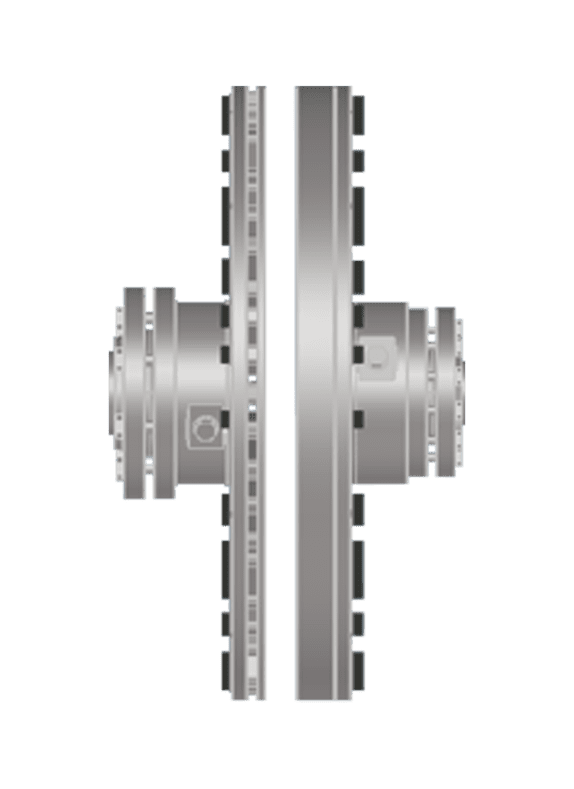
Zytec's non-contact drives are engineered specifically to address the root causes of unplanned downtime in rotating equipment. By eliminating physical contact between the motor and driven equipment, they remove the wear mechanisms — elastomers, gear teeth, friction elements, lubrication systems — that drive the majority of coupling-related failures. The practical result is a fundamentally different maintenance and reliability profile for any installation where they are applied.
Key ways Zytec non-contact drives reduce the cost of downtime include:
- No scheduled coupling maintenance — no element replacement, no re-lubrication, and no periodic laser alignment required, reducing both planned maintenance costs and the risk of maintenance-induced failures
- Dynamic misalignment tolerance up to 12 mm radial — thermal expansion, pipe strain, and foundation movement do not generate forces on bearings and seals, extending component life and reducing unplanned failure frequency
- Vibration reduction up to 80% — lower drivetrain vibration slows the degradation of bearings, seals, and gearboxes across the entire system, not just at the coupling
- Energy savings up to 50% — lower energy consumption reduces operating costs while simultaneously reducing thermal stress on connected equipment
- Rated service life of 20+ years — coupling performance does not degrade with age, meaning the reliability benefit compounds over the full asset lifetime
- Total cost of ownership reduction up to 50% — fewer interventions, lower spare parts consumption, and reduced downtime frequency combine to deliver a payback period that is often under two years
For maintenance engineers, plant managers, and operations decision-makers who are ready to address the cost of downtime at its source, contact Zytec to discuss how non-contact drive technology can be applied to your specific rotating equipment challenges.
Frequently Asked Questions
How do I calculate the actual cost of downtime for my specific facility?
Start by identifying your facility's hourly production value — divide your annual revenue by total operating hours to get a baseline figure. Then layer in fixed costs that continue during downtime (labor, energy overhead, depreciation), add estimated emergency labor and logistics premiums for unplanned events, and factor in any contractual penalty clauses tied to delivery commitments. For a more accurate picture, track your last three to five unplanned downtime events and calculate the fully loaded cost of each — most maintenance teams find the real figure is significantly higher than their initial estimate.
What's the best way to get started with a predictive maintenance program if we currently rely on time-based schedules?
Begin by identifying your highest-criticality assets — the machines whose failure would cause the most expensive or longest downtime — and prioritize those for condition monitoring first. Vibration analysis is typically the most practical entry point for rotating equipment because it detects developing faults in bearings, couplings, and imbalance well before failure. You don't need to instrument your entire plant at once; a targeted pilot on five to ten critical assets will generate enough data to demonstrate ROI and build the internal case for broader rollout.
How do we justify the capital investment in reliability improvements to management when downtime costs are hard to quantify?
The most effective approach is to build a conservative business case using only documented, verifiable costs from past downtime events rather than industry averages. Pull maintenance records, overtime logs, emergency purchase orders, and any contractual penalties paid in the last two to three years — these figures are auditable and carry more weight than benchmarks. Frame the investment as a risk reduction exercise with a defined payback period, and include the cost of a single avoided unplanned event as a standalone line item to make the value tangible for financial decision-makers.
Can dynamic misalignment really cause enough damage to justify upgrading drivetrain components, or is it mostly a theoretical concern?
Dynamic misalignment is a very practical, measurable problem — not a theoretical one. Thermal expansion alone can shift a motor shaft by several millimeters relative to the driven machine between cold start and full operating temperature, and this happens every single operating cycle. In conventional couplings, those forces are transmitted directly into bearings and seals, and the cumulative fatigue effect is visible in bearing replacement frequency data. Facilities that install monitoring on bearing temperature and vibration before and after addressing dynamic misalignment consistently record measurable improvements in bearing service life.
We already carry critical spares on-site — what else can we do to reduce recovery time when an unplanned failure does occur?
Spare parts availability is necessary but not sufficient on its own — recovery speed also depends on how quickly your team can safely execute the repair. Pre-written maintenance procedures for your highest-criticality assets, pre-staged tooling kits (including alignment equipment), and clearly assigned response roles all reduce the time between failure detection and machine restart. For assets where even a short downtime is extremely costly, some facilities maintain a pre-assembled spare sub-assembly (such as a complete pump-coupling-motor unit) that can be swapped in while the failed unit is repaired offline, compressing recovery time from hours to minutes.
Is there a risk that reducing maintenance intervention frequency means problems go undetected for longer?
This is a valid concern, and the answer lies in pairing reduced intervention frequency with improved condition visibility rather than simply doing less maintenance. When you eliminate wear mechanisms that previously required regular replacement — such as elastomeric coupling elements — you remove a genuine failure mode, not just the maintenance task associated with it. The remaining components should still be monitored through vibration analysis, thermography, or oil sampling so that any developing fault is caught early. The goal is fewer interventions driven by actual asset condition, not fewer interventions driven by reduced attention.
How does drivetrain vibration reduction translate into longer service life for components beyond the coupling itself?
Vibration is a fatigue mechanism — it accelerates crack propagation in metal components, degrades lubricant film in bearings, and causes fretting wear at mechanical interfaces throughout the drivetrain. When you reduce vibration at the coupling, the lower energy input propagates through the entire system: bearings run cooler and last longer, seal faces experience less oscillatory stress, and gearbox gear teeth are exposed to lower dynamic loads. This system-wide effect is why vibration reduction at the drivetrain level often produces bearing and seal life improvements that significantly exceed what would be expected from addressing the coupling alone.