Industrial downtime costs between $1,000 and $5,000 per minute depending on the industry, facility size, and production value at risk. For large-scale operations in sectors such as oil and gas, automotive, or chemical processing, that figure can climb significantly higher. The sections below break down how that number is calculated, what drives it, and how industrial facilities can take action to reduce it.
How is downtime cost per minute calculated?
The downtime cost per minute is calculated by dividing the total hourly cost of a production stoppage by 60. The total hourly cost combines lost revenue, labor expenses, wasted materials, and any immediate recovery costs such as emergency maintenance or expedited parts. Dividing that sum by 60 gives a per-minute figure that reflects the true financial rate of loss during an unplanned stop.
A straightforward formula looks like this:
- Lost production value per hour: Multiply hourly output by the margin or sales value of that output.
- Labor cost per hour: Include all workers idled or diverted during the stoppage.
- Recovery and restart costs: Add emergency maintenance labor, expedited parts, and any scrap or rework generated.
- Total hourly cost divided by 60: The result is your downtime cost per minute.
It is important to note that this formula captures only direct costs. The full picture includes indirect and hidden costs that do not appear in a simple production-loss calculation. Those are covered in the section on hidden costs below.
What is the average cost of industrial downtime per hour?
The average cost of industrial downtime per hour ranges from roughly $50,000 to over $500,000 for large manufacturing or process facilities, with wide variation by sector. Smaller plants may experience losses in the range of a few thousand dollars per hour, while a major refinery or automotive assembly line can lose several hundred thousand dollars for every hour of unplanned stoppage.
Several factors determine where a specific facility falls within that range:
- Production throughput value: A facility producing high-margin products loses more per hour than one producing commodity goods at low margins.
- Labor intensity: Operations with large crews idled during a stoppage accumulate labor costs rapidly, even when those workers are not producing output.
- Contractual obligations: Facilities operating under delivery contracts or service-level agreements face penalty clauses that add to the direct financial loss.
- Restart complexity: Continuous processes such as chemical production or paper manufacturing require lengthy restart sequences, extending the effective downtime window beyond the mechanical failure itself.
Industry experience consistently shows that organizations underestimate their true hourly downtime cost because they focus on lost revenue alone and overlook the compounding effect of restart costs, labor waste, and downstream disruption.
What are the hidden costs of unplanned downtime?
The hidden costs of unplanned downtime typically double or triple the visible production loss figure. These are costs that do not appear in a simple revenue-loss calculation but accumulate across the organization every time a line or piece of equipment goes down unexpectedly.
The most significant hidden cost categories include:
- Emergency maintenance premiums: Unplanned repairs require technicians at short notice, often at overtime or contractor rates, and may involve expedited shipping charges for critical spare parts.
- Quality and scrap losses: Equipment that fails mid-process often ruins in-progress batches or requires rework, creating material waste that is rarely captured in downtime cost estimates.
- Downstream disruption: A single failure in one part of a production chain can idle multiple downstream processes, multiplying the labor and output loss far beyond the affected machine.
- Customer and contractual impact: Late deliveries damage customer relationships, trigger penalty clauses, and can result in lost future orders that are difficult to quantify but very real in their financial consequence.
- Maintenance-induced risk: Emergency repairs increase exposure to human error. Incorrect reassembly, imperfect alignment, or missed fasteners during rushed interventions can introduce new failure modes that generate secondary downtime events.
- Regulatory and safety costs: In regulated industries, unplanned stops may trigger mandatory reporting, inspections, or compliance reviews that consume management time and resources.
Research in reliability engineering consistently identifies these indirect costs as the dominant element of total downtime cost, often exceeding the direct production loss by a significant margin. Organizations that track only lost output are systematically underestimating the financial case for reliability investment.
Which industries have the highest downtime costs?
The industries with the highest downtime costs per hour are those combining high production value, continuous processes, and significant contractual exposure. Oil and gas, automotive manufacturing, chemical processing, and semiconductor fabrication consistently rank among the most expensive sectors for unplanned stoppages.
Oil, gas, and chemical processing
Continuous process industries such as oil refining and chemical manufacturing face compounded losses because shutting down and restarting a process is not instantaneous. Restart sequences can take hours or days, meaning the financial impact of a single equipment failure extends well beyond the mechanical repair time. Safety and environmental compliance requirements add further cost layers, as unplanned releases or pressure events trigger mandatory reporting and investigation procedures.
Water, wastewater, and HVAC
While individual equipment values in water and HVAC applications may be lower than in heavy process industries, the consequence of failure in these sectors is service disruption to large populations or facilities. Municipal water utilities, hospital HVAC systems, and large building management installations face reputational, regulatory, and public health consequences that translate into significant financial and operational risk when pumps or fans fail unexpectedly.
Mining and pulp and paper
These industries combine high-value continuous production with remote or difficult operating environments where replacement parts and specialist technicians are not readily available. A conveyor or pump failure in a remote mining operation can halt an entire extraction process for days while logistics are arranged, making the per-event cost extremely high even if the per-hour rate appears moderate.
What causes the most unplanned downtime in rotating equipment?
The leading causes of unplanned downtime in rotating equipment are mechanical wear, misalignment, and vibration. These three failure drivers are interconnected: misalignment generates vibration, vibration accelerates wear on bearings and seals, and worn components eventually fail without warning, triggering an unplanned stoppage.
Industry sources attribute roughly 30 to 50 percent of rotating machinery failures to misalignment alone. In practical terms, this means that even equipment that was correctly aligned at installation will drift out of tolerance during operation due to thermal expansion, pipe strain, foundation movement, and seasonal temperature variation. These dynamic misalignment forces are transmitted through conventional mechanical couplings directly into motor bearings and driven equipment, accelerating degradation with every operating hour.
Other significant contributors include:
- Bearing and seal failure: Often a consequence of misalignment and vibration rather than a primary failure mode in isolation.
- Lubrication breakdown: Inadequate, contaminated, or incorrectly specified lubrication shortens component life and is a frequent root cause in maintenance-intensive environments.
- Maintenance-induced failures: Research in human factors and reliability engineering identifies maintenance interventions themselves as a significant source of failure events. Every time a coupling is disassembled, realigned, and reassembled, there is a probability of error that can introduce new failure modes.
- Overcapacity operation: Systems running at partial load for extended periods can develop instability, cavitation in pumps, or surge conditions in fans and compressors, all of which shorten equipment life.
Understanding these root causes is essential for any facility serious about reducing its production downtime cost, because the most effective interventions target the failure mechanism rather than the symptom.
How can industrial facilities reduce downtime costs?
Industrial facilities reduce downtime costs most effectively by eliminating root causes of failure rather than optimizing their response to it. Faster emergency maintenance and larger spare parts inventories reduce recovery time, but they do not prevent the failure event. The highest-impact strategies address the mechanical and operational conditions that generate unplanned stoppages in the first place.
Key approaches include:
- Condition monitoring and predictive maintenance: Continuous vibration, temperature, and current monitoring allows maintenance teams to detect degradation early and schedule interventions before failure occurs, converting unplanned stops into planned ones.
- Eliminating misalignment as a recurring failure driver: Addressing the dynamic misalignment problem at the drivetrain level removes the primary mechanical stress that accelerates bearing and seal wear.
- Reducing maintenance intervention frequency: Every scheduled maintenance event carries a risk of maintenance-induced failure. Technologies and designs that extend inspection intervals and eliminate wear consumables structurally reduce the number of human-error exposure events over an asset's lifetime.
- Right-sizing system capacity: Eliminating overcapacity in pump and fan systems reduces mechanical stress, energy consumption, and the instability conditions that contribute to premature failure.
- Standardizing spare parts and procedures: Reducing the complexity of the maintenance task reduces the probability of error and the time required to complete a repair, both of which lower the cost per event.
How Zytec helps reduce industrial downtime costs
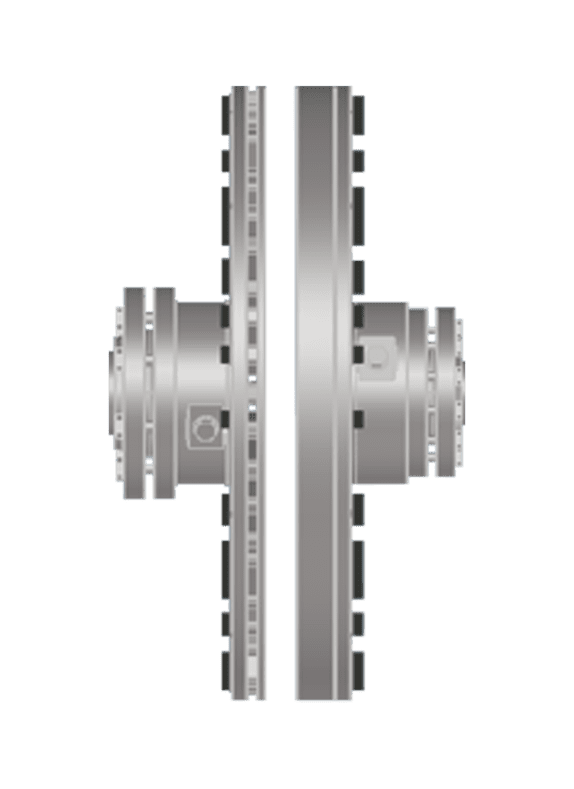
Zytec's non-contact magnetic drives directly address the root causes of unplanned downtime in rotating equipment. By eliminating physical contact between the motor and driven equipment, Zytec's technology removes the wear mechanisms, misalignment forces, and vibration transmission that are responsible for the majority of bearing, seal, and coupling failures in pumps, fans, compressors, and conveyors.
The practical impact on downtime cost is significant and measurable:
- No mechanical wear: Without elastomers, gear teeth, or friction elements, there are no wear consumables to replace and no degradation over time. Coupling service life extends to the full lifetime of the installation.
- No alignment requirement: Zytec drives tolerate up to 12 mm of dynamic radial misalignment without transmitting force into bearings or seals, eliminating the primary mechanical stress that drives premature failure.
- Vibration reduction up to 80%: Lower vibration levels extend the life of every downstream component in the drivetrain, reducing the frequency and cost of bearing and seal replacements.
- Fewer maintenance interventions: With no scheduled coupling inspection or element replacement required, the number of human-error exposure events over an asset's life is structurally reduced.
- Energy savings up to 50%: The A-TORQ drive eliminates overcapacity in pump and fan systems, reducing both energy costs and the operational stress conditions that contribute to premature failure.
For facilities where rotating equipment is central to production, the financial case is straightforward: lower failure rates mean fewer unplanned stops, and fewer unplanned stops mean a dramatically lower cost of unplanned downtime over the asset's lifetime. Zytec's technology typically delivers a payback period of under two years. Contact Zytec to discuss how non-contact drives can reduce downtime costs in your specific installation.
Frequently Asked Questions
How do I calculate the downtime cost for my specific facility if I don't have detailed financial data?
Start with the three most accessible figures: your facility's hourly revenue output, your total labor cost per hour for the affected area, and an estimate of average emergency maintenance spend per event. Even a rough calculation using these three inputs will give you a defensible baseline figure. From there, apply a multiplier of 2x to 3x to account for hidden costs such as downstream disruption, scrap, and contractual penalties — this is consistent with what reliability engineering research typically finds when full cost tracking is in place.
What is the difference between planned and unplanned downtime costs, and does planned maintenance really save money?
Unplanned downtime is consistently more expensive than planned maintenance stops because it combines production loss with emergency labor premiums, expedited parts costs, and a higher probability of secondary failures caused by rushed repairs. Planned maintenance allows you to schedule the stop at the lowest-impact time, use standard-rate labor, pre-order parts at normal cost, and follow a controlled procedure that reduces human error risk. The financial gap between the two is large enough that converting even a fraction of unplanned events into planned ones typically delivers a significant return on investment in predictive maintenance tools or reliability-improving technologies.
How do I build a business case for reliability investment when management only focuses on maintenance budget, not downtime cost?
The most effective approach is to reframe the conversation in terms of total cost of ownership rather than maintenance spend. Document two or three recent unplanned downtime events and calculate their full cost using the formula in this post — including hidden cost categories such as labor waste, scrap, and any customer penalties incurred. Presenting a concrete per-event cost figure alongside the investment required to prevent recurrence typically shifts the discussion from a cost-center framing to an ROI framing, which is far easier to approve at the budget level.
Can condition monitoring alone eliminate unplanned downtime, or does it need to be combined with other strategies?
Condition monitoring is a powerful tool for detecting degradation early, but it works best when paired with interventions that slow the rate of degradation in the first place. If the root cause — such as chronic misalignment or excessive vibration — is not addressed, condition monitoring will detect failures earlier but will not reduce their frequency. The most effective reliability programs combine monitoring with root-cause elimination, so that the underlying mechanical conditions generating wear are removed and the monitoring system serves as a safety net rather than the primary line of defense.
How quickly can a facility realistically expect to see a reduction in downtime after implementing reliability improvements?
The timeline depends on the type of improvement and the failure modes being targeted. Technologies that eliminate a root cause — such as removing misalignment forces from a drivetrain — begin delivering benefit from the moment they are installed, and the impact becomes measurable within the first full maintenance cycle or after the first avoided failure event. Predictive maintenance programs typically require three to six months of baseline data collection before they begin generating reliable early warnings. In both cases, facilities with high downtime frequency tend to see the financial impact most quickly, simply because there are more events to prevent.
Are there common mistakes facilities make when trying to reduce downtime costs that end up making the problem worse?
One of the most common mistakes is increasing the frequency of preventive maintenance intervals in response to repeated failures, which actually increases the number of maintenance-induced failure opportunities rather than reducing them. Another frequent error is replacing failed components like bearings and seals without investigating the root cause, meaning the replacement part is exposed to the same damaging conditions and fails on a similar timeline. A third mistake is treating downtime reduction as purely a maintenance department responsibility, when the largest cost drivers — such as system design, operating conditions, and contractual risk — require cross-functional involvement from engineering, operations, and finance.
Does the $1,000–$5,000 per minute figure apply to smaller industrial facilities, or is it only relevant for large-scale operations?
The $1,000–$5,000 per minute range reflects a broad industry average that includes facilities of varying sizes, so smaller operations will typically sit at the lower end of that range or potentially below it in absolute terms. However, the relative financial impact of downtime on a smaller facility can be proportionally just as severe, particularly if the facility operates under tight delivery schedules, has limited redundancy, or depends on a single critical piece of rotating equipment. Calculating your own per-minute figure using the formula in this post will give you a number that is specific and defensible for your operation, regardless of where it falls within the published range.