What is the difference between planned and unplanned downtime?
Planned downtime and unplanned downtime are the two primary categories of production downtime in industrial manufacturing. Planned downtime is a scheduled, controlled stop that operations teams anticipate and prepare for. Unplanned downtime is an unexpected halt caused by equipment failure or process breakdown, with no preparation and no defined endpoint.
The distinction matters because the two types of downtime have fundamentally different cost profiles, risk levels, and management strategies. Planned downtime, while still a loss of productive capacity, allows teams to coordinate resources, schedule labor, pre-order spare parts, and minimize the duration of the stop. Unplanned downtime offers none of those advantages. When equipment fails without warning, production stops immediately, and the recovery process begins from a standing start.
What counts as planned downtime?
Planned downtime includes any production stop that is scheduled in advance and managed as part of a maintenance or operational strategy. Common examples include:
- Preventive maintenance intervals on rotating equipment such as pumps, fans, and compressors
- Scheduled lubrication, coupling element replacement, and laser alignment checks
- Regulatory inspections and safety compliance checks
- Product changeovers and line reconfigurations
- Planned shutdowns for capital upgrades or system overhauls
What counts as unplanned downtime?
Unplanned downtime covers any production halt that occurs outside of a scheduled window. This includes sudden mechanical failures, electrical faults, process upsets, and failures triggered by deferred maintenance. In rotating equipment applications, the most common triggers are bearing failure, seal leakage, coupling damage, misalignment-induced vibration, and overload events. Because these failures are not anticipated, the response time, repair duration, and total impact are all significantly harder to control.
What causes unplanned downtime in industrial equipment?
Unplanned downtime in industrial equipment is most commonly caused by mechanical wear, misalignment, vibration, and maintenance-induced failures. In rotating equipment specifically, the failure chain typically begins with a coupling, bearing, or seal degrading under operational stress until it reaches a critical threshold and fails, stopping the driven process entirely.
Misalignment is one of the most significant root causes in rotating machinery. Industry experience consistently points to misalignment as responsible for a substantial share of rotating machinery failures and a large proportion of costs related to rotating machinery breakdowns. Misalignment generates continuous dynamic loading on bearings and seals, accelerating wear and shortening component life well below design expectations.
Vibration compounds the problem. When a coupling transmits torsional oscillations or shock loads into the drivetrain, every connected component operates under elevated stress. Bearings, seals, gearboxes, and structural interfaces all degrade faster than they would under stable load conditions. This creates a cascading failure pattern where one degraded component accelerates the wear of adjacent components.
Maintenance-induced failures represent another significant and often underappreciated cause of unplanned downtime. Every intervention on rotating equipment creates an opportunity for human error: incorrect bolt torque, imperfect realignment, missing fasteners, or incorrect reassembly. Research into reliability and human factors consistently identifies maintenance interventions as a meaningful contributor to equipment failures. The more frequently a machine requires scheduled maintenance, the greater the cumulative probability of an error that leads to premature failure.
How much does unplanned downtime cost manufacturers?
Unplanned downtime costs manufacturers across multiple dimensions simultaneously: lost production output, emergency labor, expedited spare parts, contractor coordination, and the indirect cost of disrupted delivery schedules and customer commitments. The total cost is almost always higher than the direct repair bill suggests, because the secondary consequences accumulate rapidly once an unplanned stop occurs.
The direct repair cost of an unplanned failure includes not just the failed component but also the labor required to diagnose the fault, isolate the equipment, complete lockout and permit-to-work administration, disassemble the drivetrain, realign the replacement components, and recommission the system. In regulated industries, this process involves multiple sign-off stages that extend the total outage duration well beyond the physical repair time.
The indirect costs are often larger. Lost production during an unplanned stop cannot always be recovered, particularly in continuous process industries such as chemical manufacturing, water treatment, and pulp and paper. If a critical pump or fan fails, the downstream process may also halt, multiplying the production loss across the entire line. In asset-intensive sectors where rotating equipment is central to daily output, a single unplanned failure on a critical asset can eliminate hours or days of production value.
From a total cost of ownership perspective, the purchase price of a coupling or drive component is the smallest element in the lifecycle cost equation. The dominant cost drivers are the secondary consequences of failures and interventions: downtime, lost production, contractor coordination, spare parts logistics, and the risk premium of non-routine emergency work.
How can planned downtime be reduced without increasing risk?
Planned downtime can be reduced by eliminating the maintenance requirements that make scheduled stops necessary in the first place. The most effective strategy is to select components and drive technologies that have no wear consumables, no lubrication requirements, and no periodic element replacement schedules. When the maintenance intervals disappear, so does the planned downtime associated with them.
Conventional rotating equipment drivetrains require regular coupling inspections, lubrication, element replacement, and laser realignment after each intervention. Each of these tasks generates a planned maintenance stop. Across a typical industrial plant with dozens of rotating equipment installations, these recurring intervals accumulate into a significant share of total planned downtime over the asset lifecycle.
Condition monitoring provides a complementary strategy. By tracking vibration signatures, temperature trends, and operating parameters continuously, maintenance teams can extend intervals between planned stops and intervene only when degradation data justifies it. This moves maintenance from a calendar-driven model to a condition-driven one, reducing unnecessary stops while maintaining safety margins.
Misalignment management is another lever. Because misalignment accelerates bearing and seal wear, eliminating dynamic misalignment forces from the drivetrain extends the time between necessary maintenance interventions. Drive technologies that tolerate operational misalignment without transmitting those forces into connected components allow maintenance intervals to stretch significantly, reducing the frequency of planned stops without increasing the risk of unplanned failures.
What is the relationship between downtime and total cost of ownership?
Downtime, both planned and unplanned, is the primary driver of total cost of ownership (TCO) for rotating equipment in industrial manufacturing. The acquisition cost of equipment is a one-time expense; downtime generates recurring costs across the entire operational life of the asset. Over a typical 15 to 20-year asset lifecycle, cumulative downtime costs routinely exceed the original capital investment by a significant margin.
TCO analysis for rotating equipment must account for:
- Planned maintenance labor, including lockout procedures, disassembly, alignment, and recommissioning
- Consumable spare parts such as coupling elements, seals, and lubricants
- Lost production during both planned and unplanned stops
- Emergency contractor costs during unplanned failures
- Energy consumption across the full operating profile
- The compounding effect of misalignment-induced bearing and seal wear on component replacement frequency
Reducing downtime frequency and duration directly reduces the TCO of an installation. A drivetrain that requires no scheduled coupling maintenance, no periodic laser realignment, and no lubrication eliminates entire categories of recurring cost. When bearing and seal life extends because the coupling no longer introduces dynamic overloads, the replacement intervals for those components also lengthen, further reducing lifecycle spend.
Energy consumption adds another dimension. Equipment running at overcapacity or with misalignment-induced losses consumes more electricity than a correctly matched, well-aligned installation. Over thousands of operating hours, the energy cost difference between an optimized and an unoptimized installation can represent a substantial share of total lifecycle cost. Organizations that evaluate rotating equipment on purchase price alone consistently underestimate the true cost of ownership.
How Zytec Non-Contact Drives Address Industrial Downtime
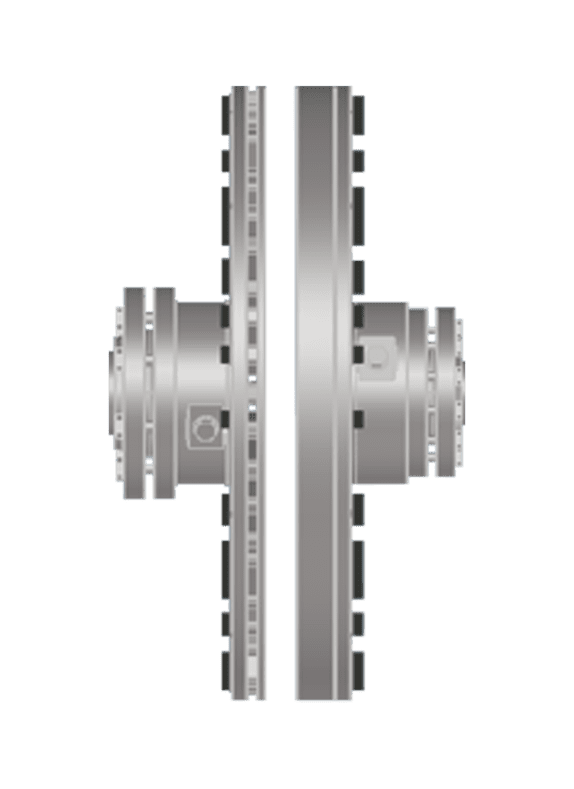
Zytec's non-contact magnetic drives are engineered specifically to target the root causes of both planned and unplanned downtime in rotating equipment applications. By eliminating physical contact between the motor and driven equipment, Zytec drives remove the wear mechanisms, misalignment sensitivities, and maintenance requirements that generate the majority of downtime events in conventional drivetrains. The practical results include:
- No scheduled coupling maintenance for the life of the installation, eliminating the planned downtime associated with periodic inspections, lubrication, element replacement, and laser realignment
- Vibration reduction up to 80%, protecting bearings, seals, and connected equipment from the dynamic overloads that accelerate wear and trigger unplanned failures
- Dynamic misalignment tolerance of up to 12 mm radial, meaning thermal expansion and foundation movement do not propagate damaging forces into the drivetrain during operation
- Energy savings up to 50%, reducing the operating cost component of total cost of ownership across the full asset lifecycle
- Payback periods often under two years, making the investment case straightforward for maintenance engineers, plant managers, and procurement teams evaluating long-term ROI
- Rated service life exceeding 20 years with no wear consumables, no lubrication, and no alignment-induced bearing or seal overload
For industrial organizations where rotating equipment is central to daily production and downtime carries a high operational cost, Zytec's non-contact drive technology offers a measurable step change in reliability and total cost of ownership. Contact Zytec to discuss how a non-contact drive can be applied to your specific installation and to receive a TCO comparison against your current drivetrain configuration.
Frequently Asked Questions
How do I calculate the true cost of unplanned downtime for a specific piece of rotating equipment in my plant?
Start by identifying your hourly production value for the line or process the equipment supports, then multiply that by the average duration of past unplanned stops — including diagnosis, permitting, repair, realignment, and recommissioning time. Add emergency labor rates, expedited spare parts costs, and any contractor premiums on top of the lost production figure. Most plants find the total is 3–5x the direct repair cost alone, which is why even a modest reduction in unplanned failure frequency delivers a strong financial return.
What is the best way to get started with reducing unplanned downtime if our maintenance team has limited resources?
Begin by ranking your rotating equipment assets by criticality — the machines whose failure would immediately halt production or cause a safety event. Focus your initial reliability improvements on those assets first, since that is where unplanned downtime carries the highest cost. Even simple steps like implementing vibration checks on critical pumps and fans, auditing alignment after every maintenance intervention, and reviewing coupling inspection schedules can deliver measurable reductions in failure frequency before any capital investment is required.
Can condition monitoring alone eliminate unplanned downtime, or does it need to be combined with other strategies?
Condition monitoring is a powerful tool for detecting degradation before it becomes a failure, but it works best as one layer of a broader reliability strategy rather than a standalone solution. It can tell you that a bearing is wearing faster than expected, but if the root cause — such as misalignment or vibration from a worn coupling element — is not addressed, the same failure pattern will repeat after the next repair. The most effective approach combines condition monitoring with root cause elimination, meaning selecting components and drive technologies that reduce the underlying stresses that cause wear in the first place.
How significant is maintenance-induced failure as a downtime risk, and what practical steps can reduce it?
Maintenance-induced failure is more significant than most plants formally track, because failures that occur shortly after an intervention are often logged as equipment failures rather than human error. Practical steps to reduce it include implementing torque specifications and checklists for every reassembly task, requiring laser alignment verification after every drivetrain intervention, and conducting post-maintenance functional checks before returning equipment to full load. Reducing the total number of required maintenance interventions — by selecting components with longer or zero-maintenance intervals — also directly reduces the cumulative probability of an error-induced failure over the asset lifecycle.
Is a 12 mm misalignment tolerance realistic for industrial installations, and what conditions typically cause that level of shaft offset?
Yes, 12 mm of dynamic radial misalignment is a realistic and practically relevant tolerance for many industrial environments. Thermal expansion alone can shift shaft centerlines by several millimeters between cold start and full operating temperature on large pumps, fans, and compressors. Foundation settlement, pipe strain, and structural flex under load contribute additional offset that conventional couplings cannot accommodate without transmitting damaging forces into bearings and seals. A drive technology that tolerates this level of dynamic misalignment without contact or force transmission removes a root cause of wear that most plants are managing reactively rather than eliminating.
How should maintenance engineers present a TCO-based investment case for reliability upgrades to plant management or procurement teams?
Frame the case around the full lifecycle cost gap between the current drivetrain configuration and the proposed alternative, rather than comparing purchase prices. Quantify your current planned downtime hours per year for the target assets, apply your plant's hourly production value, and add recurring consumable and labor costs over a 10–15 year horizon. Then model the alternative scenario with reduced or eliminated maintenance intervals, lower failure rates, and any energy savings included. Presenting a payback period alongside a 10-year net cost comparison is typically the most persuasive format for both engineering and financial stakeholders.
What industries or applications see the greatest downtime reduction benefit from non-contact drive technology?
The highest-impact applications are typically in continuous process industries — chemical manufacturing, water and wastewater treatment, pulp and paper, food processing, and power generation — where a single equipment failure can halt an entire downstream process and recovery time is measured in hours rather than minutes. These industries also tend to operate rotating equipment in harsh environments with significant thermal cycling, vibration, and pipe strain, which are exactly the conditions that accelerate wear in conventional drivetrains. High-duty-cycle assets such as critical pumps, induced draft fans, and compressors that run continuously at or near full load are prime candidates for the reliability and TCO benefits that non-contact drive technology delivers.