Why do most RCA investigations stop at symptoms?
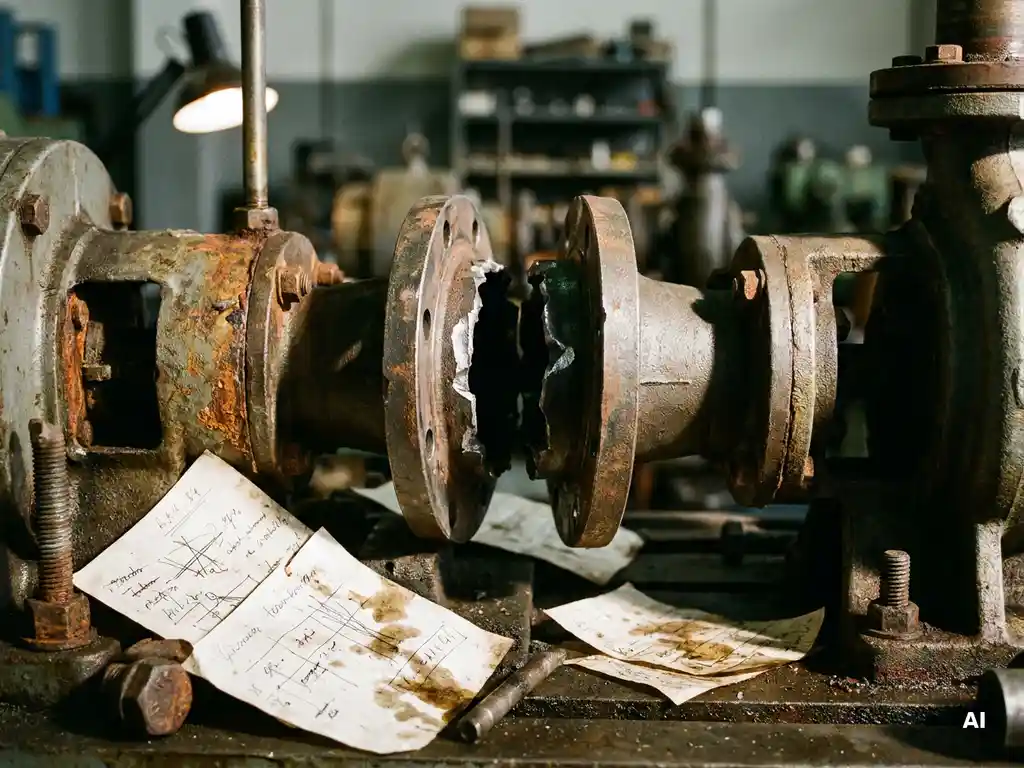
Most RCA investigations stop at symptoms because the first plausible explanation feels like an answer. When a pump fails, "the bearing seized" is technically correct — but it is a symptom, not a cause. The real root cause analysis mistake here is confusing the point of failure with the reason for failure. Stopping at symptoms means the underlying condition remains unchanged and the failure will recur.
This pattern is especially common under time pressure. When production is down and management wants answers quickly, the investigation team is pushed toward fast conclusions. The bearing gets replaced, the machine restarts, and the event gets closed. Within months, the same failure appears again — sometimes on the same asset, sometimes on an identical one nearby.
Effective root cause analysis requires deliberately asking "why" beyond the first answer. A bearing seizure might trace back to lubrication failure, which traces back to an incorrect maintenance interval, which traces back to a specification that was never updated after a process change. Each layer reveals a different corrective action. Stopping at the first layer addresses nothing systemic.
In industrial environments with rotating equipment — pumps, fans, compressors, conveyors — symptoms are almost always mechanical events. The root causes are almost always organizational, procedural, or design-related. Investigators who treat mechanical failure as the end of the analysis will keep replacing parts without ever reducing failure rates.
What happens when the wrong people lead an RCA?
When the wrong people lead a root cause analysis, the investigation is shaped by the leader's assumptions, blind spots, and organizational position rather than by evidence. A common RCA process error is assigning the investigation to whoever is most senior or most available — rather than whoever has the right combination of technical knowledge, process familiarity, and investigative independence.
The seniority trap
Senior managers often lead RCAs because they have authority to implement corrective actions. But authority and investigative skill are not the same thing. A plant manager who leads an RCA into a maintenance failure may unconsciously steer the investigation away from systemic issues — particularly if those issues reflect resourcing decisions they made. The investigation becomes a defense of existing practices rather than an honest examination of what went wrong.
The proximity problem
Assigning the RCA to the team directly involved in the failure creates a different distortion. People who were present during the event have valuable knowledge, but they also have a natural interest in the outcome. They may omit details that implicate their own actions, not out of dishonesty but because memory itself is shaped by context and self-perception. Industrial root cause analysis works best when the team includes both people close to the event and at least one person with no direct stake in the outcome.
The ideal RCA team is cross-functional: a technical lead who understands the equipment, a process engineer who understands the operating context, a maintenance representative who knows the service history, and a facilitator trained in structured investigation methods. When this mix is absent, the investigation reflects only one perspective — and that perspective will have gaps.
How does confirmation bias affect root cause analysis?
Confirmation bias affects root cause analysis by causing investigators to seek evidence that supports their initial hypothesis rather than evidence that tests it. This is one of the most damaging root cause analysis pitfalls because it is largely invisible — the team believes they are being objective while systematically filtering out contradictory information. The result is an investigation that confirms what was already believed rather than discovering what actually happened.
Confirmation bias typically enters the process at the hypothesis stage. Someone with experience says "this looks like a seal failure" and the team begins collecting evidence of seal failure. Evidence that points elsewhere — an unusual vibration pattern, a recent process change, a deviation in operating parameters — gets noted and then set aside as "probably not relevant." The investigation closes with the seal as the cause, the seal gets replaced, and the actual driver of the failure continues unchecked.
Structured investigation methods exist specifically to counteract this tendency. Techniques like fault tree analysis, fishbone diagrams, and barrier analysis force investigators to consider multiple causal pathways simultaneously rather than pursuing a single hypothesis. When teams use these tools correctly, they map possible causes before collecting evidence — which prevents the evidence-gathering process from being shaped by a pre-existing conclusion.
A practical check against confirmation bias is to assign one team member the explicit role of challenging the leading hypothesis. Their job is to find evidence that contradicts the current conclusion. This is uncomfortable in practice but consistently improves investigation quality. In industries where equipment failures carry safety consequences, this kind of structured skepticism is not optional — it is a professional obligation.
What are the most common documentation mistakes in RCA?
The most common documentation mistakes in RCA are recording what happened without recording why decisions were made, omitting timeline detail, and treating the final report as the only document that matters. Poor documentation is a root cause analysis mistake that compounds over time — when the same failure recurs years later, the organization has no usable record of what was investigated, what was ruled out, and why.
- Incomplete timelines: RCA reports often describe the failure event but not the sequence of conditions that preceded it. A timeline that begins at the moment of failure misses the hours, days, or weeks of degradation signals that were present but unrecognized.
- Missing evidence logs: Investigators collect data, inspect equipment, and interview operators — but rarely document what evidence was considered and why certain data points were weighted more heavily than others. This makes the reasoning opaque and impossible to audit.
- Vague cause statements: Phrases like "operator error" or "inadequate maintenance" appear frequently in RCA reports and communicate almost nothing. They do not identify which specific action was wrong, under what conditions, or what systemic factor made that error possible.
- No record of ruled-out causes: A complete RCA documents not only what caused the failure but what was investigated and eliminated. Without this, future investigators repeat the same analysis from scratch.
- Reports filed and forgotten: Documentation that exists only as a PDF in a shared drive serves no function. Effective RCA documentation is linked to the asset record, referenced during future maintenance planning, and reviewed when similar failures occur elsewhere in the facility.
Good documentation discipline treats the RCA report as a living reference, not a compliance output. The test of useful documentation is simple: could a competent engineer who was not involved in the investigation read the report and fully understand what happened, what was found, what was ruled out, and why the chosen corrective actions were expected to prevent recurrence?
Why do corrective actions from RCA fail to prevent recurrence?
Corrective actions from RCA fail to prevent recurrence most often because they address the symptom rather than the root cause, or because they are defined but never properly implemented. This is the final and most consequential of the common RCA errors — an investigation can be conducted well and still produce no lasting improvement if the corrective actions are weak, vague, or unenforceable.
Several failure patterns repeat consistently across industries:
- Actions assigned without ownership: A corrective action that says "maintenance team to review lubrication procedures" will not happen if no specific person is responsible and no deadline is set. Effective corrective actions name an individual, a completion date, and a verification step.
- Actions that rely on behavior change alone: Telling people to be more careful is not a corrective action. Human behavior is unreliable under pressure, fatigue, and time constraints. Corrective actions that depend entirely on individuals remembering to do something differently will fail. Actions that change the system — redesigning a process, modifying equipment, installing a physical barrier — are inherently more durable.
- Corrective actions that address only the immediate cause: If the RCA identified five contributing factors but the corrective action plan addresses only one, four failure pathways remain open. Recurrence is not a matter of if but when.
- No verification of effectiveness: Many organizations close corrective actions when the action is completed, not when it is confirmed to have worked. Closing a work order for a replaced seal does not confirm that the underlying cause of seal failure has been eliminated.
The strongest corrective actions are those that make the failure physically or procedurally impossible — or at minimum, make the failure visible before it becomes critical. In rotating equipment applications, this often means addressing the design conditions that created the failure mode in the first place, rather than relying on improved inspection frequency to catch the same problem earlier next time.
When should an RCA be escalated to a deeper investigation method?
An RCA should be escalated to a deeper investigation method when the standard process fails to identify a credible root cause, when the same failure has recurred despite previous corrective actions, or when the consequences of the failure are severe enough to warrant a more rigorous approach. Recognizing when a basic RCA is insufficient is itself a critical competency — and skipping escalation is a common RCA pitfall in organizations that treat all failures as equally straightforward.
Standard RCA methods — five whys, fishbone analysis, basic fault trees — are well suited to contained, well-understood failure types with clear causal chains. They become inadequate when the failure involves multiple interacting systems, latent organizational factors, or conditions that are difficult to reproduce or observe directly.
Deeper investigation methods include:
- Failure Mode and Effects Analysis (FMEA): Appropriate when a recurring failure suggests a systemic design vulnerability rather than an isolated event.
- Bow-tie analysis: Useful for failures with significant safety or environmental consequences, where both prevention and mitigation barriers need to be mapped and evaluated.
- MORT (Management Oversight and Risk Tree): A structured method for identifying organizational and management system failures that contributed to the event, particularly relevant in high-hazard industries.
- Third-party independent review: When internal investigations have repeatedly failed to prevent recurrence, external expertise removes the organizational blind spots and political constraints that distort internal findings.
The decision to escalate should be based on failure severity, recurrence history, and the complexity of the causal chain — not on available time or budget. A failure that recurs three times after corrective actions have been applied is not a maintenance problem. It is an investigation problem, and it requires a different approach.
How Zytec helps reduce the need for RCA investigations
The most effective way to reduce RCA workload is to eliminate the failure modes that generate investigations in the first place. Zytec's non-contact drives are engineered specifically to remove the mechanical conditions that most commonly trigger rotating equipment failures — and therefore the RCA investigations that follow them.
Key ways Zytec technology reduces failure frequency and investigation burden:
- No wear components: Zytec's non-contact drives contain no elastomers, no lubrication systems, no friction elements, and no gear teeth. The absence of wear mechanisms eliminates the degradation pathways that most often trigger bearing failures, seal failures, and misalignment-related breakdowns.
- Misalignment tolerance by design: Dynamic misalignment — caused by thermal expansion, pipe strain, and foundation movement — is one of the leading contributors to rotating equipment failures. Because Zytec drives transmit torque across an air gap without physical contact, operational misalignment introduces no forces into bearings or seals. The failure mode simply does not exist.
- Reduced maintenance interventions: Every maintenance intervention on rotating equipment is a probability event for human error. By eliminating scheduled coupling element replacement and re-alignment requirements, Zytec drives structurally reduce the number of human-error exposure events over an asset's lifetime — and therefore the number of maintenance-induced failures that require investigation.
- Extended P-F curve: The time between detectable degradation and functional failure is extended significantly compared to conventional coupling installations, giving maintenance teams more time to act before a failure event occurs and an RCA becomes necessary.
- Up to 80% vibration reduction: Vibration is both a symptom and a cause of rotating equipment degradation. Reducing it at the source lowers stress on every downstream component — bearings, seals, gearboxes, and structural interfaces — extending the intervals between failure events.
If your organization is conducting repeated RCA investigations on the same rotating equipment assets, the underlying issue may be a design condition that no corrective action will permanently resolve. Contact Zytec to find out how non-contact drive technology can eliminate the failure modes driving your investigation workload.
Frequently Asked Questions
How do we know when our RCA process has actually identified the true root cause and not just another symptom?
A reliable signal that you have reached a true root cause is when the answer to 'why' points to a systemic factor — a policy gap, a design condition, a resource decision — rather than another mechanical event. If your corrective action involves replacing or repairing a physical component, you have almost certainly stopped at a symptom. A genuine root cause will produce a corrective action that changes a process, a standard, a design parameter, or an organizational behavior — something that structurally prevents the failure pathway from existing, not just addresses its latest expression.
What is the most practical way to get started with structured RCA if our team has no formal training?
The fastest entry point is the five whys technique applied with a strict rule: every answer must be supported by evidence, not assumption. Start by mapping a simple timeline of the failure event — what was observed, when, and by whom — before asking any causal questions. This discipline alone eliminates most of the premature conclusions that derail informal investigations. Once your team is comfortable with evidence-based causal chains, introduce a fishbone (Ishikawa) diagram to ensure you are considering equipment, process, human, environmental, and organizational factors simultaneously rather than defaulting to the most obvious category.
How should corrective actions be prioritized when an RCA identifies multiple contributing factors?
Prioritize corrective actions using two criteria: causal proximity and failure mode permanence. Actions that address the highest-level systemic cause take priority over those that address immediate triggers, because they close more failure pathways at once. Within that ranking, prefer actions that make the failure physically or procedurally impossible over actions that rely on improved human vigilance — the latter degrade under workload and time pressure. If resources are limited, a useful rule is to implement at least one action at each causal level identified in the investigation rather than concentrating all effort on a single layer.
What is the most common mistake organizations make when closing out an RCA investigation?
The most common close-out mistake is treating completion of the corrective action as proof of effectiveness. Replacing a component, updating a procedure, or delivering a training session are outputs — they are not outcomes. A properly closed RCA includes a defined verification step: a follow-up inspection, a performance metric review, or a specified observation period that confirms the failure mode has not recurred. Without this step, organizations accumulate a backlog of 'closed' investigations that have not actually resolved anything, which becomes visible only when the same failure returns.
How do we prevent RCA findings from being ignored or deprioritized after the investigation is complete?
The most effective structural safeguard is linking corrective actions to the asset's maintenance management system — not just filing the report — so that outstanding actions appear in work queues alongside routine maintenance tasks. Assign each action to a named individual with a hard completion date and a designated reviewer, and schedule a formal effectiveness review at a fixed interval after closure. Organizations that treat RCA follow-through as a reliability KPI, reviewed at the same cadence as equipment availability and maintenance cost, consistently achieve higher corrective action completion rates than those that rely on voluntary follow-up.
Can RCA be applied effectively to near-misses and minor failures, or is it only worth the effort for major events?
Applying RCA to near-misses and minor failures is often where the highest return on investigative effort is found. Near-misses share the same causal chain as major failures — the only difference is outcome, not process. A minor seal leak investigated thoroughly today may prevent a catastrophic bearing failure six months from now on the same or an identical asset. A proportionate approach works well in practice: use a lightweight structured method (five whys with an evidence log) for lower-severity events, and reserve full cross-functional investigations for high-severity or recurring failures. The key is consistency — investigating every qualifying event rather than only the ones that caused visible damage.
How do we handle an RCA when the evidence has been lost or disturbed before the investigation begins?
Disturbed or missing evidence is a common challenge in industrial RCA, particularly when production pressure leads to rapid equipment repair before the investigation team arrives. When physical evidence is unavailable, shift the investigation focus to process data — historian trends, alarm logs, maintenance records, and operator shift notes from the period preceding the failure. Structured interviews with everyone present during and before the event, conducted separately to avoid group recall bias, can recover significant causal detail. Critically, use the evidence gap itself as a finding: if your organization routinely loses failure evidence to rapid restart pressure, that is a systemic vulnerability that belongs in the corrective action plan.