What are the biggest hidden costs of manufacturing downtime?
The biggest hidden costs of manufacturing downtime are the indirect losses that never appear on a single line in a maintenance report: idle labor wages, spoiled or scrapped materials, expedited freight to meet delayed orders, overtime premiums to recover lost output, and the long-term erosion of customer confidence. These costs routinely exceed the visible cost of the repair itself by a factor of two to five.
Most manufacturers track the direct cost of a stoppage, meaning the value of lost production for the hours the line stood still. But that figure significantly understates the real financial impact. Consider what happens simultaneously during an unplanned stop:
- Idle labor: Operators, supervisors, and quality staff remain on the payroll while producing nothing. In shift-based environments, this cost accumulates immediately.
- Material waste: In continuous processes such as chemical production, food manufacturing, or paper mills, a sudden stop can ruin in-process batches entirely.
- Expedited logistics: When a production delay threatens a customer delivery, manufacturers often absorb premium freight costs to close the gap.
- Overtime recovery: Catching up on missed output typically requires overtime shifts, which carry a wage premium of 25 to 50 percent above standard rates.
- Emergency parts procurement: Unplanned failures force buyers to source replacement components urgently, often at prices far above negotiated contract rates.
- Customer penalties and contract risk: Repeated delivery failures can trigger financial penalties and, over time, drive customers toward more reliable competitors.
The hidden nature of these costs is precisely what makes them dangerous. Because they are distributed across labor, logistics, and commercial budgets rather than concentrated in a single maintenance cost center, they are easy to undercount and difficult to attribute directly to equipment reliability failures.
How much does one hour of downtime cost a manufacturer?
The cost of one hour of manufacturing downtime varies widely by industry, plant size, and product value, but industry experience consistently places the figure in the range of tens of thousands to hundreds of thousands of euros or dollars per hour for mid-to-large industrial operations. For high-throughput sectors such as automotive, oil and gas, or continuous chemical processing, a single unplanned hour can represent losses exceeding six figures.
Several variables determine where a specific plant falls within that range:
- Throughput value: A plant producing high-margin specialty chemicals loses far more per hour than one producing bulk commodity materials at the same volume.
- Fixed cost absorption: Capital-intensive facilities carry large fixed costs in depreciation, leases, and energy that continue during a stoppage regardless of output.
- Downstream dependencies: In tightly integrated supply chains, one stopped line can cascade into losses across multiple downstream operations or customer production schedules.
- Shift structure: A plant running three shifts around the clock has no slack capacity to absorb lost hours without incurring overtime or missing commitments.
A useful internal benchmark for any manufacturer is to calculate the fully loaded downtime cost per hour: take the total annual cost of production (including labor, materials, fixed overheads, and margin contribution) and divide by total operating hours. The result is typically a sobering number that reframes the economics of preventive maintenance and reliability investment entirely.
What causes unplanned downtime in manufacturing?
Unplanned downtime in manufacturing is most commonly caused by rotating equipment failures, including failures in pumps, fans, compressors, conveyors, and the mechanical couplings and drive systems that connect them to their motors. Beyond equipment failure, human error during maintenance interventions, inadequate condition monitoring, and misalignment of rotating components are consistently among the leading root causes.
Rotating equipment failures
Pumps, fans, compressors, and conveyors are the workhorses of industrial production. When a critical rotating machine fails unexpectedly, the entire process it serves stops with it. Industry sources consistently identify misalignment of rotating machinery as responsible for a significant share of rotating equipment failures, with estimates ranging from 30 to 50 percent of all breakdowns attributable to misalignment-induced stress on bearings, seals, and shafts. Vibration, bearing wear, and seal degradation follow as closely related failure modes, often triggered or accelerated by the same misalignment conditions.
Maintenance-induced failures
A less discussed but equally significant cause of unplanned downtime is failure introduced during maintenance itself. Every time a technician disassembles and reassembles rotating equipment, there is a probability of human error: incorrect bolt torque, imperfect realignment, missing fasteners, or an incorrect reassembly sequence. Multiple reliability and human factors studies identify maintenance-induced failures as a substantial contributor to equipment problems in asset-intensive plants. The more frequently a machine requires scheduled intervention, the higher the cumulative probability that one of those interventions introduces a fault that leads to an unplanned failure shortly afterward.
Condition monitoring gaps
Unplanned downtime is also a symptom of insufficient visibility into equipment health. When plants rely on time-based maintenance schedules rather than condition-based signals, they either intervene too early (wasting resources and introducing maintenance risk) or too late (missing the window to act before a failure occurs). Extending the time between detectable degradation and functional failure, what reliability engineers call the P-F curve, gives operations teams more time to plan interventions before they become emergencies.
How does downtime affect total cost of ownership (TCO)?
Downtime is one of the dominant drivers of total cost of ownership for industrial rotating equipment. The purchase price of a machine or its components is typically the smallest element in the lifecycle cost equation. The costs that accumulate over the asset's operating life, including maintenance labor, spare parts, alignment services, and production losses from unplanned stoppages, consistently dwarf the initial capital outlay.
From an asset management perspective aligned with ISO 55000 principles, the coupling and drive selection for rotating equipment directly influences TCO across several dimensions:
- Maintenance frequency: Technologies that require frequent scheduled interventions (element replacement, lubrication, re-alignment) generate recurring labor and parts costs throughout the asset's life.
- Failure-induced downtime: Each unplanned failure carries the full hidden cost structure described above, compounding over years of operation.
- Bearing and seal life: Misalignment and vibration transmitted through the drivetrain accelerate wear on bearings and seals downstream of the coupling. Replacing these components adds both parts cost and planned downtime.
- Contractor and permit costs: In regulated environments, maintenance interventions require lockout/tagout administration, permit-to-work procedures, and sometimes specialist contractors. These overhead costs are real and recurring.
The implication for procurement and asset management decisions is significant. Evaluating a drive or coupling technology purely on purchase price systematically underestimates the cost of a less reliable choice. A technology that eliminates wear components, removes the need for precision laser alignment, and structurally reduces the number of maintenance interventions over a 20-year asset life delivers TCO savings that can approach 50 percent of coupling and alignment-driven maintenance spend, depending on baseline failure rates and the plant's cost of downtime.
What's the difference between planned and unplanned downtime costs?
Planned downtime costs are predictable, budgeted, and manageable. Unplanned downtime costs are unpredictable, unbudgeted, and typically two to five times more expensive per hour than planned maintenance stops. The core difference is control: planned downtime allows operations teams to prepare, minimize idle time, and schedule recovery, while unplanned downtime triggers immediate cascading losses with no preparation window.
During planned downtime, a plant can:
- Schedule the stop during a low-demand production window
- Pre-order parts at negotiated prices and have them on-site
- Arrange maintenance contractors in advance at standard rates
- Notify customers and adjust delivery commitments proactively
- Coordinate parallel tasks to minimize total time offline
Unplanned downtime strips away every one of those advantages. Parts must be sourced urgently. Contractors are called in at emergency rates. Customers receive late deliveries without advance warning. Overtime is deployed reactively. The repair itself may take longer because the failure mode was not anticipated and the right tools or expertise are not immediately available.
This is why reliability-focused manufacturers invest heavily in shifting their downtime profile from unplanned to planned, and from planned to eliminated entirely where possible. Every hour of unplanned downtime that is converted into a scheduled, controlled maintenance window represents a significant cost reduction even if the total maintenance hours remain the same.
How can manufacturers reduce downtime and its financial impact?
Manufacturers can reduce downtime and its financial impact by addressing the root causes of equipment failure rather than simply responding faster to breakdowns. The most effective strategies combine condition monitoring to extend the detection window before failure, drivetrain engineering choices that eliminate wear mechanisms, and maintenance practices that reduce the frequency and risk of human intervention near rotating equipment.
Key approaches include:
- Condition-based maintenance: Moving from fixed-interval maintenance schedules to monitoring-driven interventions allows plants to act on real equipment health signals rather than calendar dates, reducing both unnecessary interventions and missed failure warnings.
- Vibration and alignment management: Since misalignment is responsible for a disproportionate share of rotating equipment failures, systematic attention to alignment quality and vibration levels at installation and during operation pays dividends across the entire drivetrain.
- Drivetrain component selection: The choice of coupling or drive technology directly determines how much maintenance a rotating system requires over its life. Technologies that eliminate wear components, require no lubrication, and tolerate dynamic misalignment without transmitting forces into bearings and seals structurally reduce both planned and unplanned downtime.
- Spare parts strategy: Maintaining critical spare parts on-site for high-consequence equipment reduces the time-to-repair when failures do occur, capping the production loss from any single event.
- Operator and maintenance training: Because maintenance-induced failures are a significant contributor to unplanned downtime, investing in the quality and consistency of maintenance execution reduces the probability that a scheduled intervention introduces a new fault.
The financial case for proactive reliability investment is straightforward. With unplanned downtime costing tens of thousands of euros or dollars per hour in many industrial settings, a technology or program that prevents even a small number of unplanned stops per year typically delivers a payback period well under two years.
How Zytec helps reduce production downtime losses
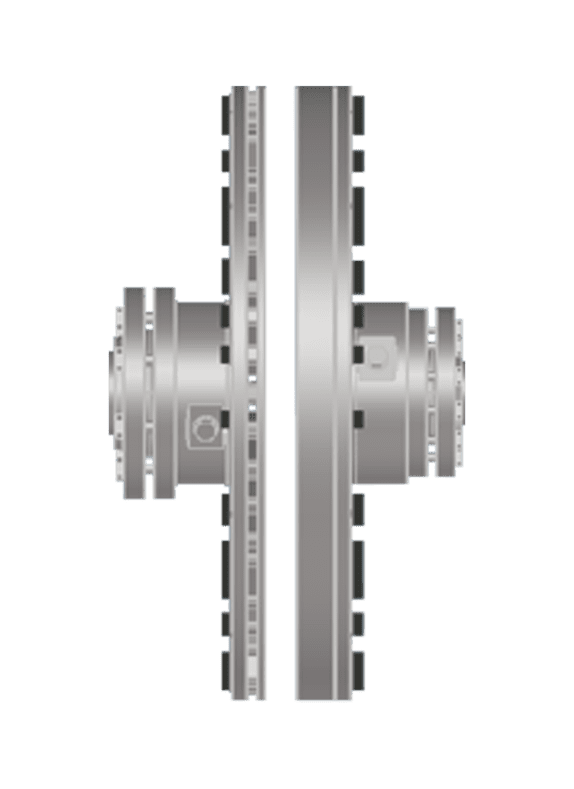
Zytec's non-contact magnetic drives are engineered specifically to address the root causes of unplanned downtime in rotating equipment. For manufacturers facing recurring failures in pumps, fans, compressors, or conveyors, the technology delivers a structural change in reliability rather than an incremental improvement.
Key ways Zytec's drives reduce downtime and its financial impact:
- No wear components: Zytec's non-contact drives contain no elastomers, no lubrication systems, no gear teeth, and no friction elements. With nothing to wear out, the coupling cannot degrade in the ways that trigger most rotating equipment failures.
- No alignment requirement: Because torque is transmitted across an air gap using powerful magnets, the drives tolerate both static and dynamic misalignment without transmitting forces into bearings or seals. This eliminates one of the leading causes of bearing and seal failure in conventional drivetrains.
- Vibration reduction up to 80 percent: By decoupling the motor from the driven machine magnetically, Zytec drives absorb torsional shocks and vibration that would otherwise propagate through the drivetrain and accelerate component wear.
- Maintenance-free operation for 20 or more years: With no scheduled coupling element replacement, no re-alignment intervals, and no lubrication requirements, the number of human maintenance interventions near rotating equipment drops dramatically, reducing both maintenance cost and the risk of maintenance-induced failures.
- Energy savings up to 50 percent: For variable-load applications such as pumps and fans, the A-TORQ drive eliminates overcapacity and delivers measurable reductions in electricity consumption alongside the reliability benefits.
- Short payback period: With total cost of ownership reductions of up to 50 percent and payback periods often under two years, the investment case is grounded in operational performance rather than speculative savings.
If unplanned downtime, high maintenance costs, or energy overcapacity are affecting your production reliability, contact Zytec to discuss how non-contact drive technology can deliver measurable results in your specific application.
Frequently Asked Questions
How do I calculate the true cost of downtime for my specific facility?
Start by calculating your fully loaded cost per production hour: divide your total annual cost of production — including labor, materials, fixed overheads, and margin contribution — by your total annual operating hours. Then apply a multiplier of two to five times that figure to account for the hidden indirect costs (idle labor, expedited freight, overtime recovery, emergency parts procurement) that accompany each unplanned stop. Running this calculation even once tends to fundamentally change how plant managers and finance teams evaluate reliability investments.
What's the best first step for a plant that wants to shift from reactive to proactive maintenance?
The most practical starting point is an equipment criticality assessment: rank every asset by the production and financial impact of its failure, then focus your initial condition monitoring and spare parts investment on the top tier. For rotating equipment specifically, establishing a baseline vibration and alignment measurement at installation gives you a reference point to detect early degradation before it becomes a failure. Trying to transform the entire maintenance program at once is rarely successful — starting with your highest-consequence machines delivers the fastest return and builds internal confidence in the approach.
How much of our downtime is likely coming from maintenance activities themselves rather than spontaneous equipment failure?
Industry research and reliability studies consistently point to maintenance-induced failures as a significant and often underestimated contributor — in some asset-intensive plants, interventions gone wrong account for 20 to 40 percent of unplanned stoppages. Every disassembly and reassembly of rotating equipment carries a statistical probability of human error, and that probability compounds over years of repeated scheduled interventions. If your CMMS data shows a pattern of failures occurring within days or weeks of a completed maintenance work order, maintenance-induced failure is a strong candidate as the root cause.
Can reducing vibration in rotating equipment really make a measurable difference to bearing and seal life?
Yes — bearing and seal life are highly sensitive to vibration levels because fatigue damage accumulates with every vibration cycle, and the relationship is non-linear. Even moderate reductions in vibration amplitude can translate into disproportionately large extensions in component life. For example, an 80 percent reduction in vibration transmitted through a drivetrain can extend bearing life by a factor of several times, depending on the original vibration severity and bearing load conditions. This is why vibration isolation at the coupling level — rather than only addressing vibration after it has already propagated through the drivetrain — is such a high-leverage intervention.
How should we build the business case for reliability investment when finance teams focus primarily on capital budgets?
The most persuasive approach is to reframe the conversation from capital expenditure to cost avoidance and operating expense reduction. Quantify your current annual downtime cost using the fully loaded calculation described in this post, then model the impact of eliminating even one or two unplanned stops per year. Complement that with documented reductions in maintenance labor, spare parts consumption, and contractor spend over the asset lifecycle. Presenting a payback period — ideally under two years — alongside a 10- or 20-year TCO comparison gives finance teams the language and numbers they need to evaluate the investment on its actual economic merits rather than its purchase price alone.
Are non-contact magnetic drives suitable for all types of rotating equipment, or only specific applications?
Non-contact magnetic drives are particularly well-suited to applications where reliability is critical, maintenance access is difficult or costly, and the driven machine is a pump, fan, compressor, or conveyor — which covers the majority of rotating equipment in most industrial plants. They are especially valuable in hazardous or regulated environments where every maintenance intervention requires lockout/tagout, permit-to-work procedures, or specialist contractors, since reducing intervention frequency has an outsized cost impact in those settings. For applications with highly variable loads, such as pumps and fans running at partial capacity, the additional energy efficiency benefit makes the investment case even stronger.
What common mistakes do manufacturers make when trying to reduce downtime that end up costing more in the long run?
The most common mistake is optimizing for the lowest purchase price on drivetrain components without accounting for the full lifecycle cost of that choice — a less reliable coupling or drive that costs less upfront can easily generate ten times its purchase price in downtime and maintenance costs over a 20-year asset life. A second frequent error is implementing condition monitoring technology without the internal processes or trained personnel to act on the data it generates, which means the early warning signals go unnoticed until failure occurs anyway. Finally, many plants underinvest in alignment quality at installation, treating it as a minor detail, when misalignment is in fact responsible for a disproportionate share of all rotating equipment failures downstream.